Plumbing Apprentice Prep
Water systems, drain assemblies, and practical measurements
Learn through ten complete lessons, a responsive symbolic drain and flow workbench, service-call scenarios, ten applied math tasks, and three full practice exams.
Learn the foundations, one lesson at a time
Read each lesson, try its task, and pass the knowledge check to complete it automatically. You can practice or take an exam at any time.
1The plumbing apprentice role
Learn the scope of supervised work.
The plumbing apprentice role
Learn the scope of supervised work.
Learning goals
- Understand the assignment
- Recognize different hazards
- Keep a useful record
Understand the assignment
Plumbers install and maintain water supply, drainage, waste, and vent systems. Some roles also include other systems that require additional qualifications. An apprentice learns through assigned work and instruction, not by improvising beyond authorization.
Start with the work order: identify the affected fixture, the reported problem, the permitted task, and the responsible supervisor. Confirm access and how occupants will be informed before service is interrupted.
Recognize different hazards
Hot water, pressure, sharp edges, contaminated water, electrical equipment, lifting, and confined spaces require distinct controls. A valve position alone does not prove a system is safe to open.
Gas, sewage exposure, excavation, and confined-space work are outside these browser exercises. Stop when the hazard or procedure is unclear. The employer must provide task-specific training, protective equipment, and supervision.
Keep a useful record
Separate the customer’s report from your own observation. Record location, equipment identity, authorized checks, supplied measurements, and any unresolved concern.
Describe what happened without claiming a complete diagnosis prematurely. “Moisture observed below the trap” is an observation; “all piping needs replacement” requires evidence and authority.
Try the task
Write a short intake note for a dripping sink.
Incomplete
2Supply, drainage, waste, and vent systems
Trace where water enters and where waste leaves.Locked — complete previous lessons
Supply, drainage, waste, and vent systems
Trace where water enters and where waste leaves.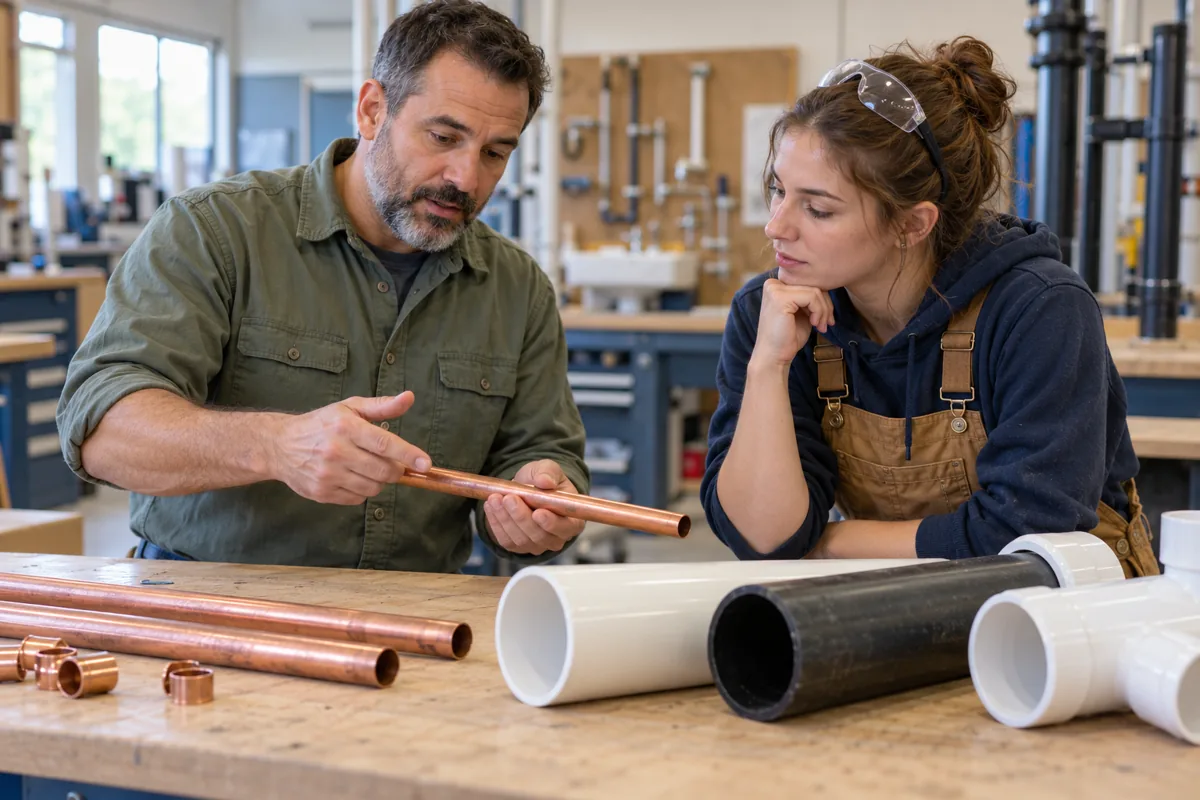
Learning goals
- Supply delivers usable water
- Drainage carries discharge
- Venting protects operation
Supply delivers usable water
A supply system carries water to fixtures under pressure. Hot and cold distribution may involve different materials and components. An apparent low-flow complaint can have several causes, so compare observations rather than assuming one fault.
Identify the system using drawings, labeling, and approved inspection. Pipe color alone is not sufficient evidence. Do not connect an unknown line to a potable supply.
Drainage carries discharge
Gravity drainage depends on a suitable route, sizing, fittings, slope, and support. A fixture drains into a system designed to convey wastewater rather than into an arbitrary downhill pipe.
The virtual course gives you a specific training drawing and target slope. Actual required slopes and configurations depend on the system, adopted code, and approved design. A classroom target is not a universal installation rule.
Venting protects operation
Vent arrangements help manage drainage-system pressure and protect trap seals. A vent is not simply another drain, and an improvised replacement can create problems.
Use the approved layout and qualified review. This course does not give dimensions for code-compliant vent placement or authorize installing a vent device.
Try the task
Describe the role of each system in one sentence.
Incomplete
3Traps, seals, and fixture connections
Understand the purpose of a water seal.Locked — complete previous lessons
Traps, seals, and fixture connections
Understand the purpose of a water seal.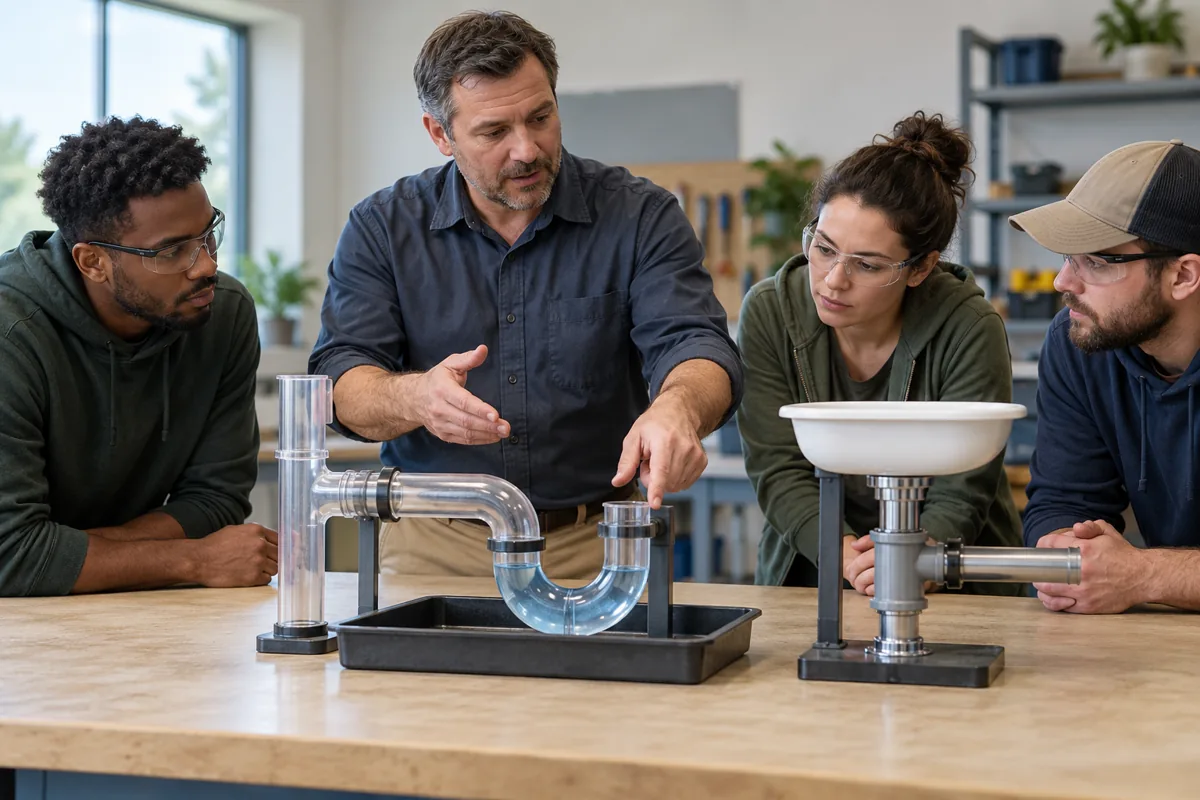
Learning goals
- Why a trap matters
- Read the assembly
- Check function after authorized work
Why a trap matters
A correctly designed trap retains a water seal that helps prevent sewer gases from entering occupied space. A dry or disturbed seal may no longer provide that barrier.
Odor is a symptom to investigate, not proof of a particular installation defect. Report observations and follow approved procedures; never enter a hazardous atmosphere to find an odor source.
Read the assembly
Identify the fixture outlet, tailpiece, trap, and downstream branch on the supplied drawing. Connections must match the product and approved arrangement.
The simulator uses symbolic slots rather than installation dimensions. A corrugated shortcut or extra trap is not a substitute for the specified components. Real selection requires local requirements and manufacturer data.
Check function after authorized work
A completed task needs the required leak and function checks and a clear handoff. Visible drainage alone does not establish that every seal, support, or vent is correct.
Record the test used and the result. If a leak or odor remains, stop and escalate instead of declaring success.
Try the task
Explain why “water drains” is not a complete acceptance test.
Incomplete
4Materials, fittings, and compatibility
Choose components from specifications.Locked — complete previous lessons
Materials, fittings, and compatibility
Choose components from specifications.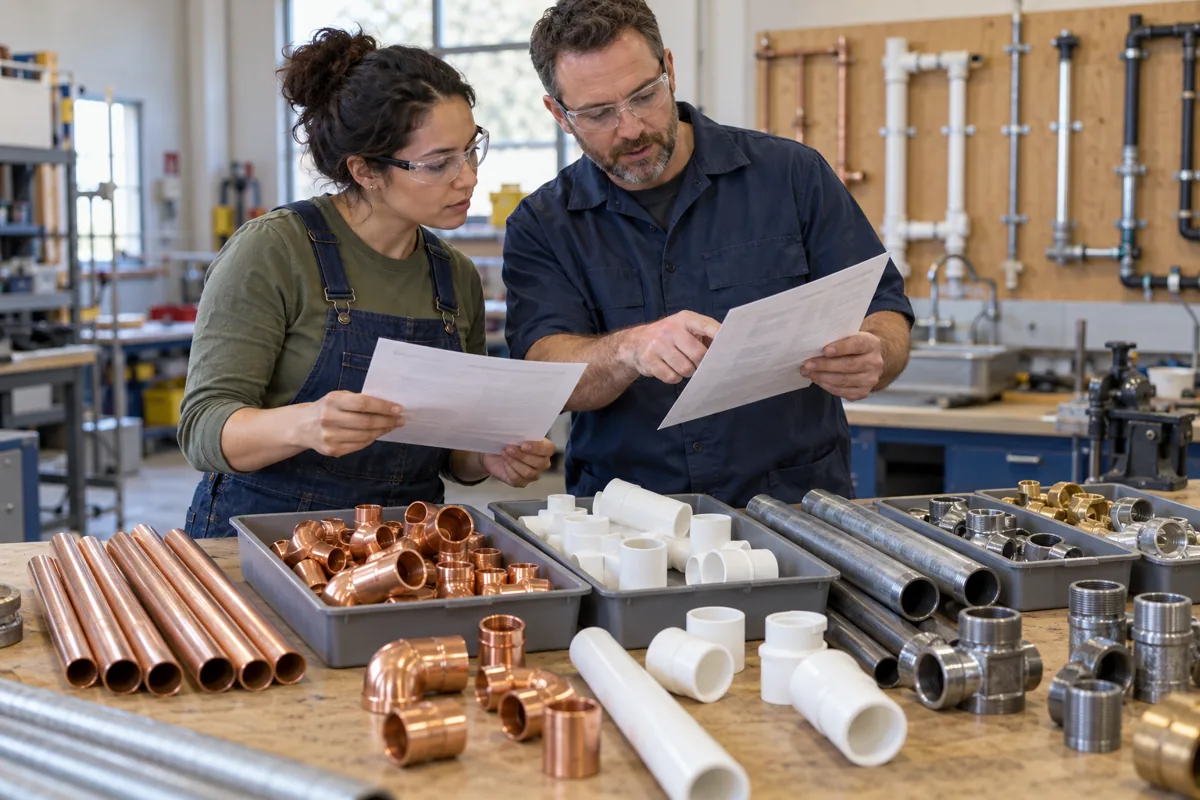
Learning goals
- Use the approved material
- Understand fitting purpose
- Handle a mismatch
Use the approved material
Material selection depends on fluid, temperature, pressure, location, adopted requirements, and the manufacturer’s rating. Appearance or a matching nominal size does not establish compatibility.
Check the approved schedule and product identification. Different joining systems require different procedures; do not infer a method from another material.
Understand fitting purpose
A fitting changes direction, connects sections, or serves another defined purpose. Drainage fitting orientation and geometry affect flow and access.
The virtual model asks for the fitting shown on the training drawing. It does not teach solvent joining, soldering, brazing, or pressure testing on real systems. Those skills require training and supervised practice.
Handle a mismatch
If a delivered part differs from the drawing, identify the exact discrepancy and ask for review. Keep uncertain material separate rather than installing it to avoid a delay.
Record model, size, rating, and the drawing revision. A supervisor can resolve the discrepancy through the approved process; a beginner should not redesign the system.
Try the task
List four checks before accepting a component.
Incomplete
5Measurements, takeouts, and supplied slopes
Calculate carefully before a cut is authorized.Locked — complete previous lessons
Measurements, takeouts, and supplied slopes
Calculate carefully before a cut is authorized.
Learning goals
- Keep units consistent
- Account for given fitting dimensions
- Apply the drawing’s slope
Keep units consistent
Convert feet to inches before combining lengths. Express fractions clearly: one-half is 0.5 and one-quarter is 0.25. Label every calculation with units.
A correct number with the wrong unit can still cause a costly error. Confirm whether the drawing shows overall, center-to-center, or finished dimensions.
Account for given fitting dimensions
A supplied takeout accounts for a fitting’s contribution to a span. For a classroom center-to-center span of 40 inches with total stated takeouts of 4 inches, the remaining straight cut is 36 inches.
Use dimensions for the actual fitting and the approved measurement method in supervised work. Never assume the classroom takeout applies to a different product.
Apply the drawing’s slope
Total fall equals horizontal run multiplied by the specified slope, with compatible units. A training drawing specifying one-quarter inch per foot over 8 feet has 2 inches of fall.
Compare a measured slope with the given specification. Do not treat this example as a code rule for every pipe size, system, or location.
Try the task
Calculate a 48-inch span minus 5 inches of supplied takeouts.
Incomplete
6Pressure, flow, volume, and leak calculations
Distinguish readings that sound similar.Locked — complete previous lessons
Pressure, flow, volume, and leak calculations
Distinguish readings that sound similar.
Learning goals
- Pressure is not flow
- Calculate volume over time
- Communicate estimated losses
Pressure is not flow
Pressure describes force per unit area; flow is a volume per unit time. A pressure reading alone does not tell you the delivered gallons per minute.
A change in pressure can have multiple causes. Compare conditions and follow the authorized diagnostic plan rather than naming a leak from one reading.
Calculate volume over time
For a steady supplied flow, volume equals flow rate multiplied by time. A fictional 2 gallons per minute for 5 minutes delivers 10 gallons.
Real flow can vary, so state the constant-flow assumption. For a rectangular teaching tank, length times width times depth gives volume when all dimensions use the same units.
Communicate estimated losses
A leak-loss estimate helps explain why a problem deserves attention, but it is not a guaranteed utility-bill calculation. Record the measurement method and uncertainty.
Do not create a real leak to measure it. Use approved observation and supplied data. Significant uncontrolled discharge needs prompt escalation under the site procedure.
Try the task
Calculate 3 gallons/minute for 4 minutes.
Incomplete
7Cross-connections and backflow awareness
Protect potable water through correct escalation.Locked — complete previous lessons
Cross-connections and backflow awareness
Protect potable water through correct escalation.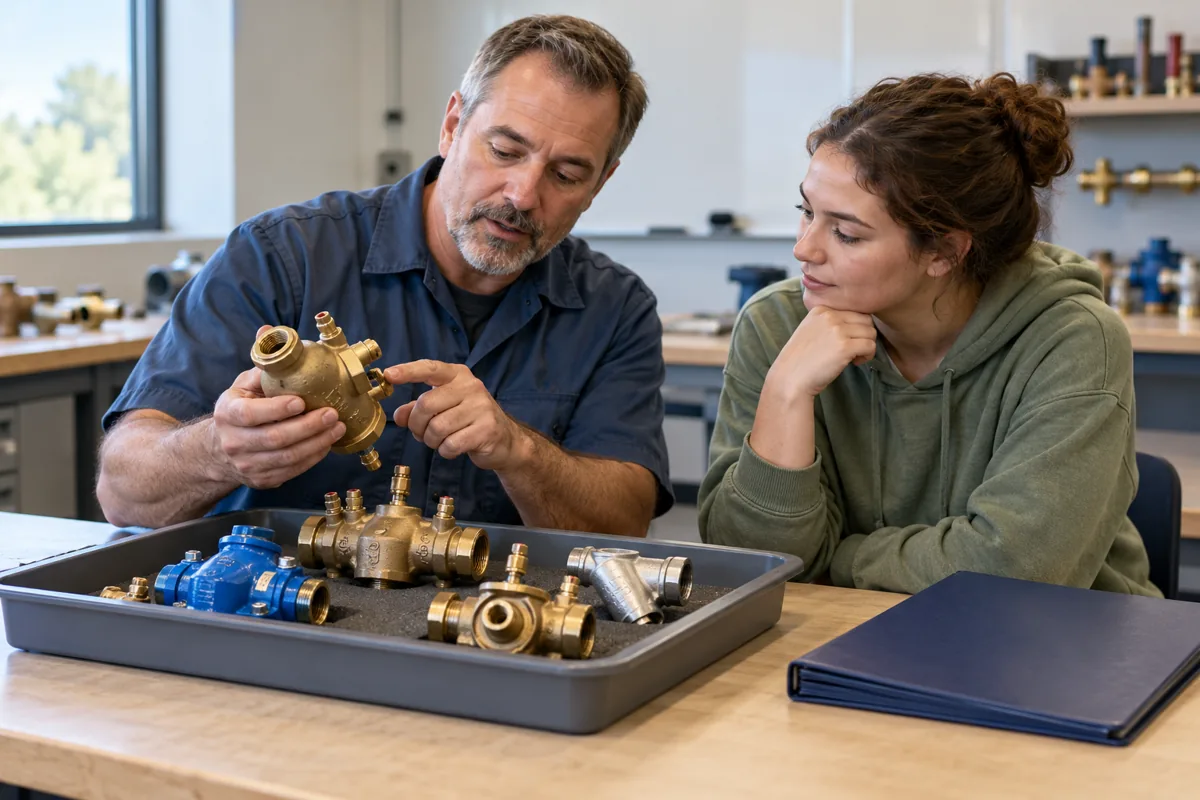
Learning goals
- Recognize a cross-connection
- Use approved protection
- Keep prevention separate from repair guessing
Recognize a cross-connection
A cross-connection is an actual or potential connection between potable water and a source that could contaminate it. A submerged hose end can create a concern even if water normally flows outward.
Backflow can occur when pressure conditions reverse the expected direction. Do not assume that normal operation prevents contamination under every condition.
Use approved protection
Suitable protection depends on the hazard, system, water authority, and adopted requirements. An air gap is a physical separation; a backflow device has its own approved application and testing requirements.
Do not choose or install protection based on a browser example. Report a suspected cross-connection and consult the qualified supervisor and responsible authority.
Keep prevention separate from repair guessing
A concern about contamination requires the site’s response procedure and appropriate notification. A casual taste or smell check cannot establish water safety.
Document the connection and observed conditions without exposing yourself or others. This course does not qualify you to test or certify backflow assemblies.
Try the task
Explain why water flowing out of the hose today does not remove the concern.
Incomplete
8Safe inspection and troubleshooting
Find evidence without exceeding your scope.Locked — complete previous lessons
Safe inspection and troubleshooting
Find evidence without exceeding your scope.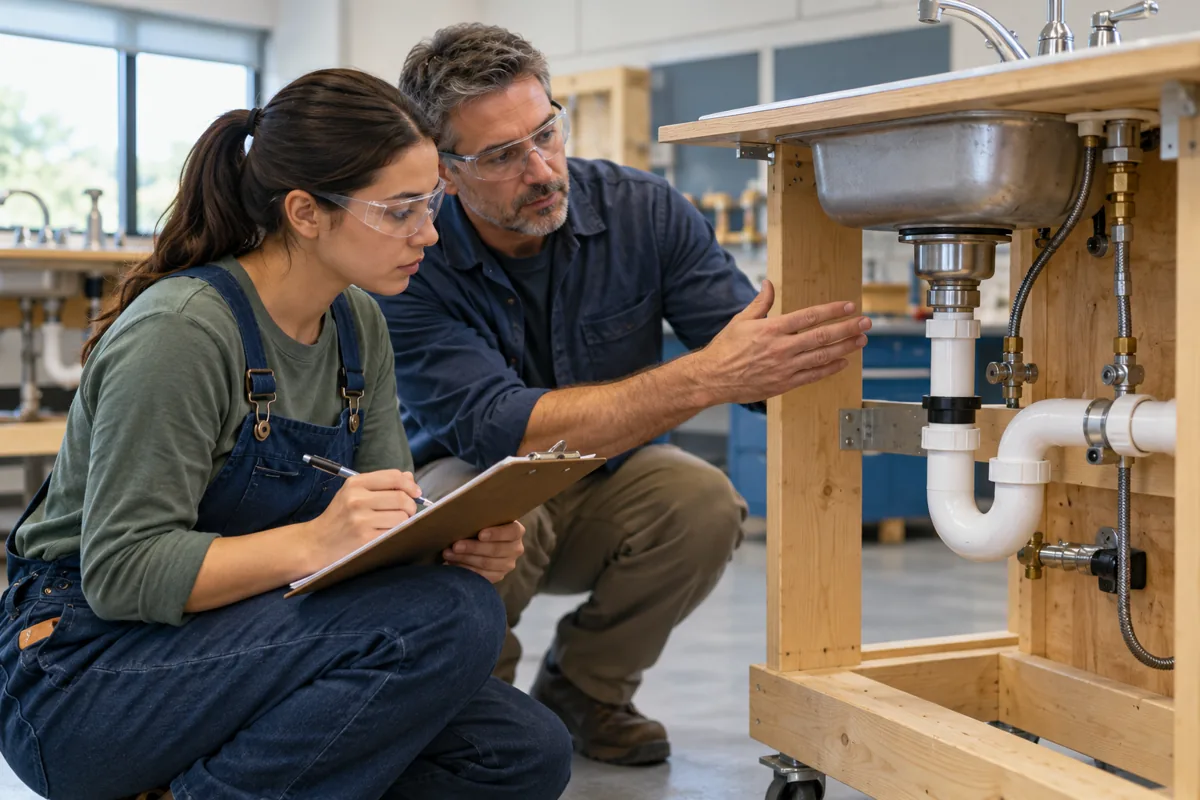
Learning goals
- Define the symptom
- Change one virtual variable
- Escalate unresolved conditions
Define the symptom
Ask whether the complaint is a leak, slow drain, odor, noise, low flow, or intermittent behavior. Record when it appears and what changed.
Confirm which fixtures are affected. One slow fixture and multiple affected fixtures may suggest different next checks, but neither observation is a complete diagnosis.
Change one virtual variable
In the teaching workbench, change a specified component or supplied slope and compare the result. Record the starting condition and the observed effect. If two settings change at once, repeat the teaching trial with one change so you can explain which condition affected the result.
Real work is less controlled. Isolation, stored pressure, temperature, contamination, and nearby electrical hazards require approved procedures before intervention.
Escalate unresolved conditions
If findings conflict with the drawing or the cause remains uncertain, give a concise handoff. Include what was observed, checked, changed with authorization, and still unresolved.
Do not use chemical mixing or an improvised compressed-air method to force an outcome. Those are not techniques taught by this course.
Try the task
Write a handoff when a leak remains after an authorized check.
Incomplete
9Verification and customer communication
Finish the task with evidence and a clear handoff.Locked — complete previous lessons
Verification and customer communication
Finish the task with evidence and a clear handoff.
Learning goals
- Follow acceptance criteria
- Explain the outcome honestly
- Record and restore
Follow acceptance criteria
Before starting, know what the assigned task must satisfy. The training assembly requires the specified components, the drawing’s slope, no modeled leak, and no modeled restriction.
Real acceptance may include inspections and prescribed tests. Only qualified personnel should perform the applicable procedures with appropriate equipment. Check which acceptance criteria belong to your assigned task and which require a separate inspection or responsible person.
Explain the outcome honestly
Use plain language to describe the approved action and the observed result. Avoid promises beyond your evidence or guarantees you cannot provide.
Ask the supervisor how to communicate unresolved concerns and any required follow-up. Respect the customer’s property and privacy.
Record and restore
Document the final authorized checks, remaining issues, and who received the handoff. Restoration of service and the work area must follow the site procedure.
Never leave an unresolved hazard unreported. If the task cannot be completed safely, stopping and communicating is a successful professional decision.
Try the task
Write a two-sentence completion note.
Incomplete
10Entering supervised plumbing training
Turn independent study into a realistic next step.Locked — complete previous lessons
Entering supervised plumbing training
Turn independent study into a realistic next step.
Learning goals
- Find a legitimate pathway
- Prepare useful evidence
- Ask informed questions
Find a legitimate pathway
Explore registered apprenticeships and local training programs through official directories. Check employer entry requirements, application windows, paid work arrangements, classroom commitments, and any local registration rules.
This LifeHelper course is independent preparation. It does not provide apprenticeship hours, a contractor license, or authorization to perform regulated work.
Prepare useful evidence
Keep sample calculations, a fictional service note, and a reflection on when you stopped for supervision. Explain that these came from browser exercises.
Practice basic arithmetic, unit conversion, reading drawings, clear communication, and reliable attendance. Learn hands-on skills through the program’s supervised instruction. Compare programs using their published curriculum, supervision arrangements, application process, and official recognition rather than promises of an instant qualification.
Ask informed questions
Ask who supervises apprentices, how safety training is delivered, how work and classroom hours are tracked, and which qualifications the pathway leads toward.
Check the official program information before paying fees. Do not assume a prep-course result guarantees selection, employment, or licensing.
Try the task
Draft a truthful learning statement for an application.
Incomplete
Reference resources and next steps
Course content reviewed October 2026. Training requirements, products, and procedures vary; check the current official instructions.
EPA: cross-connection and backflow resourcesCalifornia registered apprenticeship programsU.S. apprenticeship opportunitiesOSHA: control of hazardous energyThis is independent educational preparation, not approved apprenticeship hours, a license, an official exam, or authorization to work on real equipment. Browser models simplify physical behavior. Real tasks require applicable requirements, employer procedures, qualified supervision, and hands-on training. Supplied slope and fitting dimensions are classroom assumptions, not universal code requirements or an installation plan.