HVAC Technician Prep
Comfort systems, airflow, and EPA Section 608 foundations
Study ten complete lessons, calculate supplied readings, experiment with a live airflow and temperature model, work through service calls, and take three full practice exams.
Learn the foundations, one lesson at a time
Read each lesson, try its task, and pass the knowledge check to complete it automatically. You can practice or take an exam at any time.
1The HVAC job and a safe service process
Understand the work before reaching for tools.
The HVAC job and a safe service process
Understand the work before reaching for tools.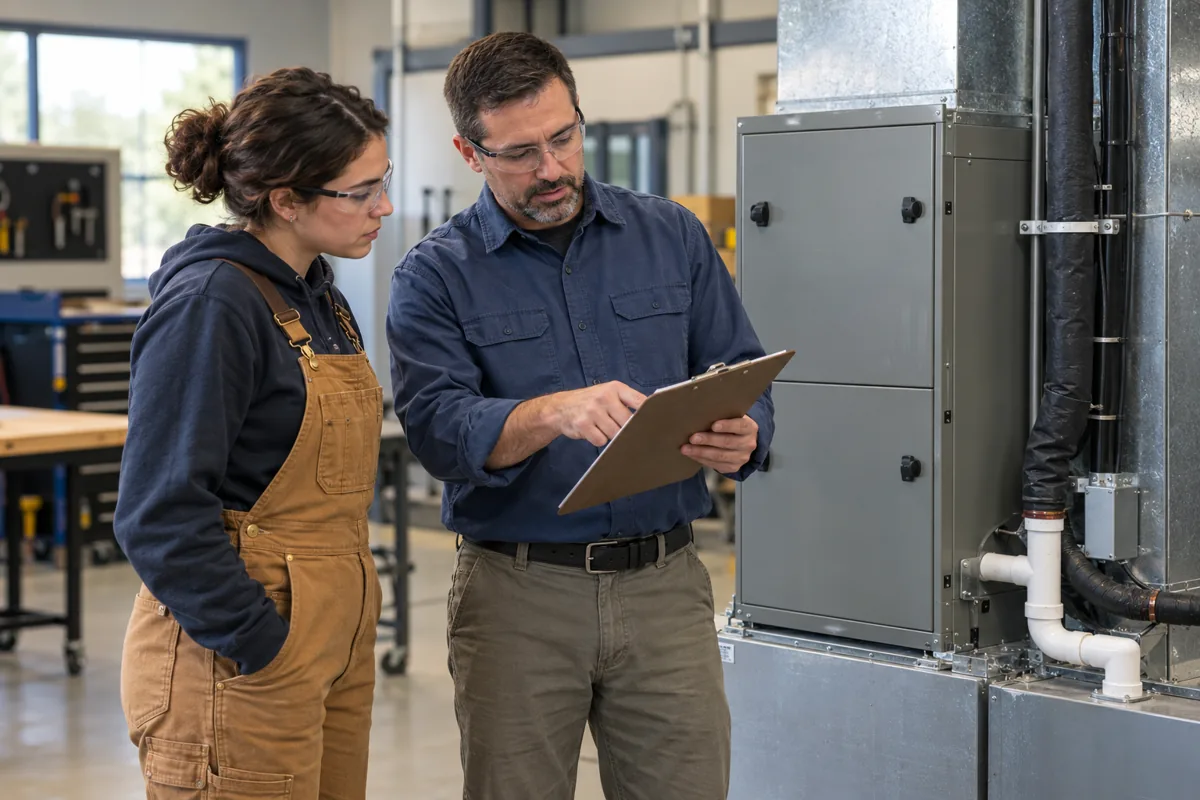
Learning goals
- Start with the complaint
- Identify the hazards
- Finish with verification
Start with the complaint
HVAC work involves comfort, ventilation, humidity, refrigeration, and safe equipment operation. A complaint such as “not cooling” is a symptom, not a diagnosis. Ask when it started, which areas are affected, and what changed.
Record the equipment identity, operating conditions, and the customer’s observations. Follow the employer’s work order and authorization. An apprentice helps within assigned duties and asks before opening equipment or interrupting a service.
Identify the hazards
Electricity, moving fans, stored capacitor energy, pressure, hot surfaces, refrigerants, heights, and combustion equipment create different hazards. A thermostat set to off does not establish safe isolation.
Authorized workers follow the equipment-specific energy-control procedure and verify the required safe condition. A beginner should stop and ask rather than improvise a test, bypass an interlock, or assume a switched-off unit is harmless.
Finish with verification
A good service record distinguishes reported symptoms, observed readings, actions, results, and unresolved concerns. Changing several things at once makes it difficult to know what helped.
Verify the outcome against the approved specification and task. Explain limitations honestly. “Cooling improved after a restricted filter was addressed” is more useful than claiming that every part is healthy without supporting checks.
Try the task
Write a five-line intake note for a warm classroom.
Incomplete
2Heat, temperature, and the refrigeration cycle
Follow energy through the four main components.Locked — complete previous lessons
Heat, temperature, and the refrigeration cycle
Follow energy through the four main components.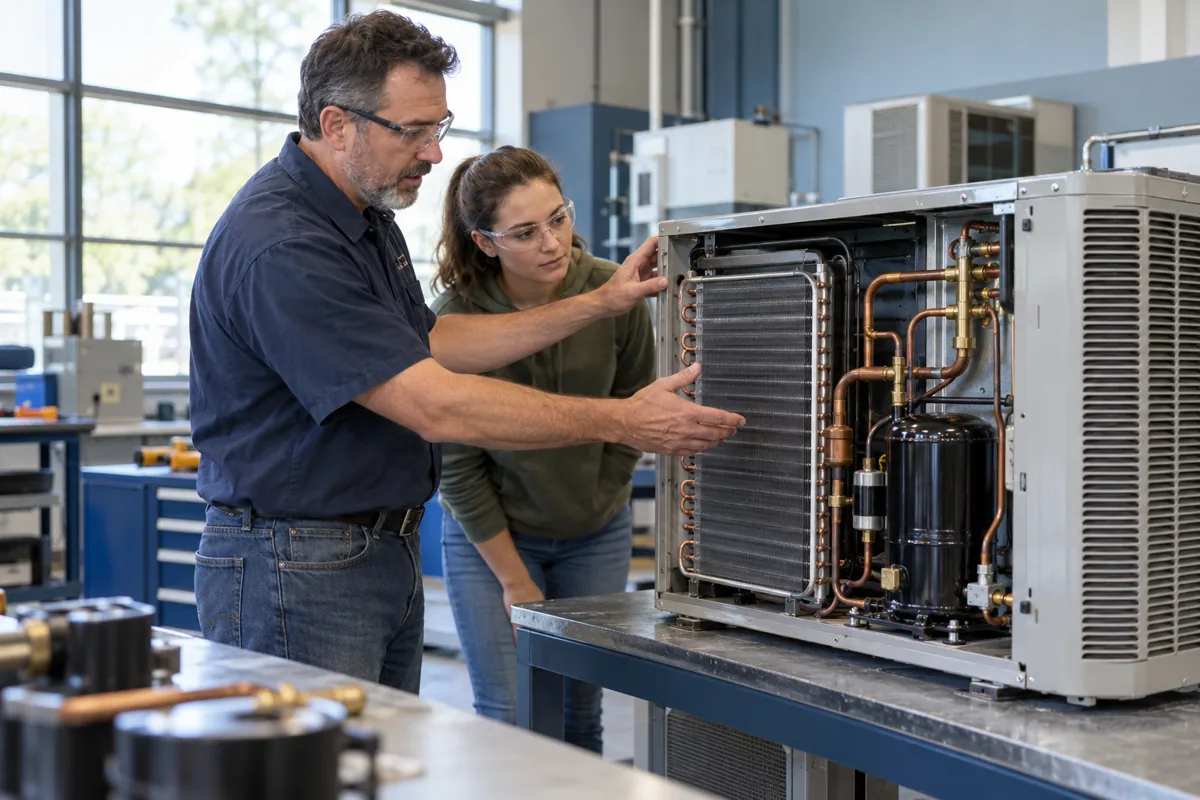
Learning goals
- Heat is transferred
- Trace the cycle
- Read measurements in context
Heat is transferred
Temperature describes how hot or cold something is; heat is energy transferred because of a temperature difference. Heat naturally flows from warmer to cooler surroundings. Refrigeration uses work to move heat where it would not naturally go.
Sensible heat changes temperature; latent heat changes phase. Evaporation can absorb energy while the substance changes from liquid to vapor. Condensation can release energy as vapor becomes liquid. These ideas explain how cooling equipment moves heat.
Trace the cycle
In a simplified cooling cycle, the evaporator absorbs heat and the compressor raises vapor pressure. The condenser rejects heat. The metering device reduces pressure and controls flow into the evaporator.
These functions matter more than memorizing a drawing orientation. A compressor is intended to compress vapor, not a stream of liquid. Heat pumps can change which coil absorbs or rejects heat; the basic cycle still uses compression, condensation, expansion, and evaporation.
Read measurements in context
Pressure and saturation temperature are related for a given refrigerant. A pressure reading without refrigerant identity and operating context cannot tell the whole story. Blends may require the appropriate dew or bubble data.
This course supplies fictional saturation temperatures for arithmetic. It does not teach a charging procedure or establish universal targets. Actual measurement and servicing require the correct data, certification where applicable, and supervised training.
Try the task
Explain why an outdoor condenser rejects heat while a room cools.
Incomplete
3Airflow, filters, coils, and ducts
Separate air-side problems from refrigerant assumptions.Locked — complete previous lessons
Airflow, filters, coils, and ducts
Separate air-side problems from refrigerant assumptions.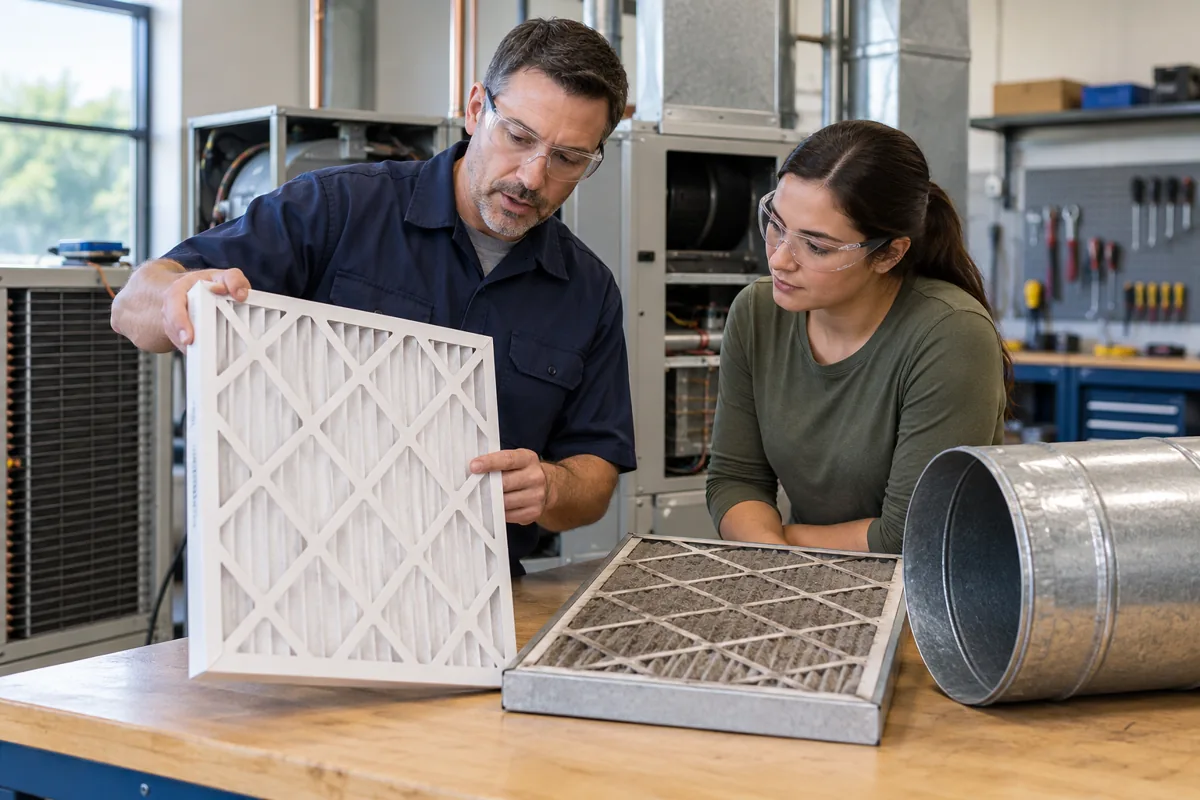
Learning goals
- Follow the air path
- Use measurements carefully
- Choose a controlled next check
Follow the air path
The return carries room air toward the equipment; supply ducts deliver conditioned air back to rooms. Filters and coils add resistance. Blocked returns, dirty filters, damaged ducts, or unsuitable components can reduce airflow.
Check the approved filter specification rather than choosing solely by appearance or maximum filtration rating. A restrictive filter can affect performance. Never run an actual system without required filtration as a shortcut.
Use measurements carefully
CFM means cubic feet per minute. For a simplified uniform flow, area in square feet multiplied by average velocity in feet per minute gives CFM. Real ducts may have uneven velocity, so field methods require appropriate instruments and sampling.
Static pressure helps describe resistance in the air path, but a reading must be compared with the equipment and measurement method. Temperature difference is another clue. Neither a single pressure nor a single temperature difference proves a particular fault.
Choose a controlled next check
Start with authorized observations and verify the system’s required airflow before concluding that refrigerant is low. Record what changes after an approved correction.
The virtual airflow simulator isolates variables so you can learn cause and effect. Real equipment contains interacting variables; you must use manufacturer procedures and qualified supervision rather than reproduce the simulator’s simplified values.
Try the task
Calculate airflow for 3 square feet at 250 feet/minute.
Incomplete
4Thermostats, heat pumps, and operating modes
Understand calls for heating and cooling.Locked — complete previous lessons
Thermostats, heat pumps, and operating modes
Understand calls for heating and cooling.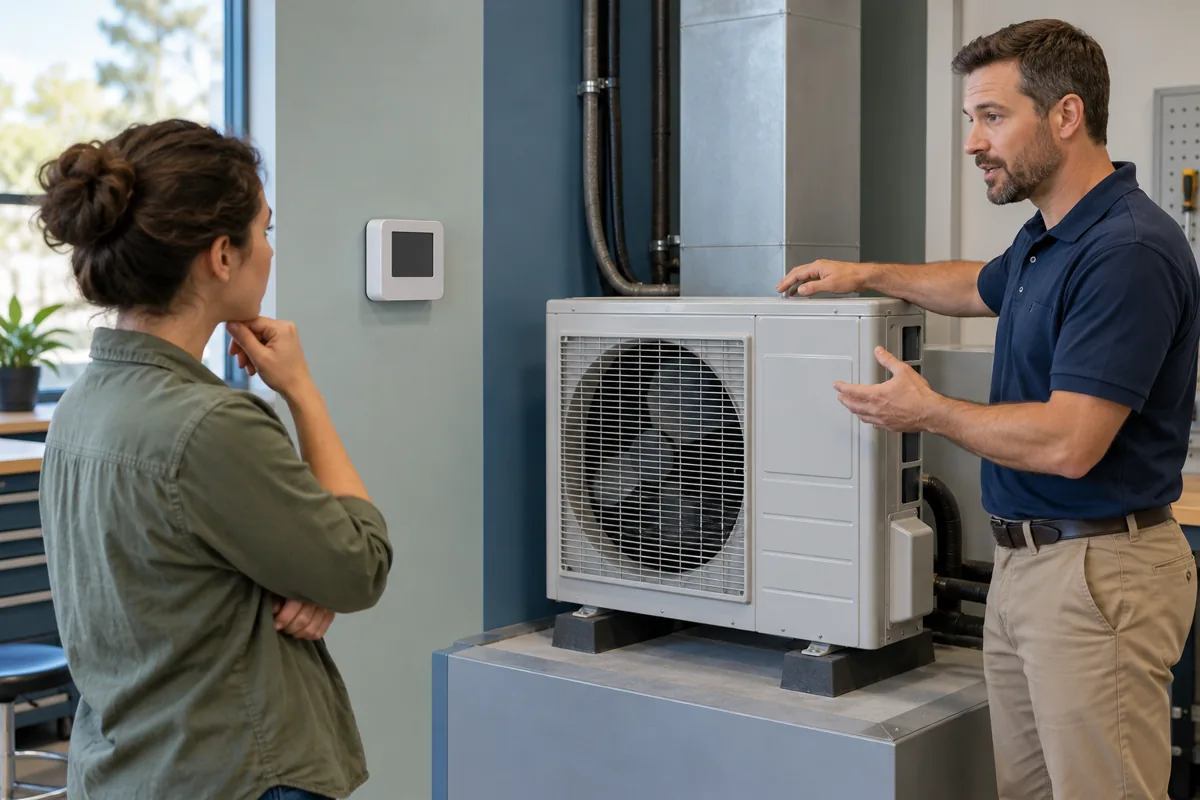
Learning goals
- Check the requested mode
- Heat pumps move heat
- Understand efficiency units
Check the requested mode
A thermostat compares a sensed temperature with a setting and sends control calls according to its design. Confirm heat, cool, off, fan settings, schedule, and the displayed temperature before assuming a component failed.
A low-voltage control circuit is not the same as the equipment’s line-voltage supply. Labels and terminals vary. Do not jump terminals or defeat controls; learn the approved schematic under supervision.
Heat pumps move heat
A heat pump transfers heat between spaces. Its reversing arrangement allows the refrigeration system to serve heating and cooling functions. Auxiliary heat may operate under specific conditions and controls.
Outdoor temperature, defrost operation, equipment capacity, and settings affect behavior. A temporary operating change may be normal, but unfamiliar noise, odor, or unsafe conditions require an appropriate inspection, not a guess.
Understand efficiency units
Input power in kW is a rate; energy in kWh depends on how long it runs. COP compares useful heat transfer rate with input power when both use compatible units.
For example, 6,000 W of delivered heat divided by 2,000 W of input gives COP 3. This arithmetic is not an equipment-sizing method and does not predict every weather condition or operating mode.
Try the task
Explain kW versus kWh to a customer.
Incomplete
5Moisture, condensate, and ventilation
Recognize water and air-quality concerns.Locked — complete previous lessons
Moisture, condensate, and ventilation
Recognize water and air-quality concerns.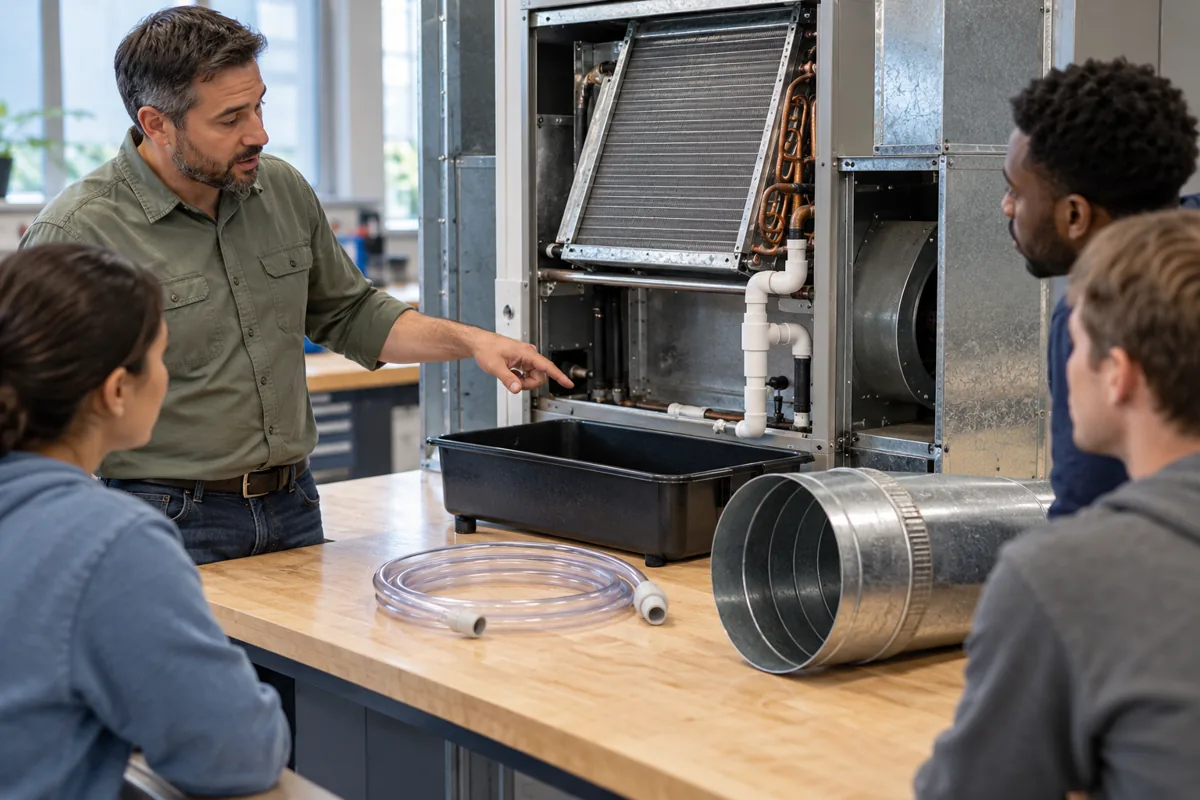
Learning goals
- Cooling can remove moisture
- Inspect visible water safely
- Ventilation is different from cooling
Cooling can remove moisture
When an evaporator surface is cold enough, water vapor can condense from air. The resulting liquid needs an approved collection and drainage path. Condensation can occur on other cold surfaces too.
Air temperature, humidity, airflow, and equipment operation interact. A lower thermostat setting does not automatically solve a humidity problem. Assess the full complaint and avoid promises based on a single reading.
Inspect visible water safely
A wet area may involve a blocked drain, pan problem, insulation issue, or another source. First protect people from slipping and avoid water near electrical hazards. Record where and when water appears.
Actual condensate drainage requirements depend on equipment instructions and local rules. Do not invent a trap, bypass an overflow safety, or connect drains casually. An apprentice’s role may be to identify and report rather than alter the system.
Ventilation is different from cooling
Ventilation brings in or removes air for an intended purpose. Recirculating cool air does not automatically provide adequate outdoor air. Filters, ventilation, source control, and maintenance address different aspects of indoor air quality.
Combustion odors, suspected gas leaks, carbon-monoxide alarms, or serious symptoms require the appropriate emergency procedure. Leave an unsafe area and contact emergency or utility services as appropriate; do not keep troubleshooting the appliance.
Try the task
Name two reasons cooling and ventilation are not interchangeable.
Incomplete
6EPA Section 608: Core foundations
Learn the certification map and environmental responsibilities.Locked — complete previous lessons
EPA Section 608: Core foundations
Learn the certification map and environmental responsibilities.
Learning goals
- Know the credential boundary
- Different environmental impacts
- Recover, recycle, and reclaim
Know the credential boundary
EPA Section 608 certification applies to specified work that can release refrigerant from covered equipment. EPA-approved organizations administer the actual tests. LifeHelper study is independent preparation, not certification or approved testing.
Type I covers small appliances, Type II covers high- or very-high-pressure appliances with stated exclusions, and Type III covers low-pressure appliances. Universal covers all these types. Check the current EPA requirements and test topics before choosing your pathway.
Different environmental impacts
CFCs and HCFCs contain chlorine and can affect stratospheric ozone. HFCs do not have the same ozone-depletion mechanism, but many have climate impacts. A refrigerant’s environmental profile is not proof that it is safe to release or suitable for any equipment.
Intentional venting during covered service is restricted. Refrigerant identity, equipment classification, current regulations, and approved procedures matter. Do not treat an old study sheet as authority for every refrigerant or every activity.
Recover, recycle, and reclaim
Recovery removes refrigerant for storage. Recycling cleans it using processes such as filtering; reclamation processes refrigerant to the applicable purity standard and involves qualified reclaimer requirements. These terms are not interchangeable.
Avoid mixing refrigerants. Identify the equipment label and approved data, and follow certification and supervision requirements. EPA rules also include a closely and continually supervised apprentice provision; it is not a general permission for unsupervised work.
Try the task
Write the difference between recovery and reclamation.
Incomplete
7Section 608 equipment types and study planning
Connect Core knowledge with equipment-specific topics.Locked — complete previous lessons
Section 608 equipment types and study planning
Connect Core knowledge with equipment-specific topics.
Learning goals
- Type I and small appliances
- Type II and Type III
- Build a complete preparation checklist
Type I and small appliances
Small-appliance classification has a regulatory definition; a device being physically small is not enough. Study the current EPA definition, recovery requirements, equipment conditions, and approved recovery methods with your official preparation materials.
For beginner work, identify the appliance and documentation before deciding a certification category. Recovery equipment compatibility and the condition of the appliance matter. Do not infer legal servicing permission from a familiar household appearance.
Type II and Type III
High-pressure and low-pressure describe refrigerant and system characteristics, not how forcefully a user opens a valve. Type II and Type III study includes different recovery, leak, evacuation, and safety considerations.
Low-pressure systems can admit air and moisture when operating below atmospheric pressure. Purge and leak-management topics therefore have specific importance. A household air-conditioning example is not a substitute for large-chiller training.
Build a complete preparation checklist
Use the official Core and Type I, II, and III topic lists to track unfamiliar areas. This foundation course introduces concepts but does not reproduce the entire official examination syllabus or equipment-specific procedures.
Study current recovery limits, cylinder handling, leak requirements, refrigerant-specific data, and provider instructions through current official materials. Requirements can depend on dates and equipment details; avoid memorizing an isolated number without its conditions.
Try the task
Explain why a refrigerator’s physical size is not enough to classify it.
Incomplete
8Readings, superheat, and subcooling
Practice interpretation using supplied data only.Locked — complete previous lessons
Readings, superheat, and subcooling
Practice interpretation using supplied data only.
Learning goals
- Pressure is not a complete diagnosis
- Calculate two temperature differences
- Use more than one clue
Pressure is not a complete diagnosis
Gauge pressure is relative to atmospheric pressure; absolute pressure uses a different reference. Always preserve units and the reference when reading technical data. A value without conditions can mislead.
In this course, readings are supplied in a fictional chart. Do not attach gauges to real equipment to reproduce the exercise. Actual gauge work is within certification, authorization, and safety requirements.
Calculate two temperature differences
Superheat compares vapor temperature with the appropriate saturation temperature. Subcooling compares the appropriate saturation temperature with liquid temperature. Subtraction direction matters.
If supplied vapor temperature is 52°F and saturation is 40°F, superheat is 12°F. If supplied condensing saturation is 105°F and liquid is 95°F, subcooling is 10°F. These example values are not recommended targets.
Use more than one clue
Airflow, load, metering device, refrigerant identity, sensor location, and manufacturer requirements affect interpretation. A calculated difference alone does not authorize adding or removing refrigerant.
Document readings and conditions. Compare them with the actual approved procedure under supervision. If data conflict, verify instruments and assumptions rather than forcing the result to fit a preferred diagnosis.
Try the task
Find superheat when the supplied vapor temperature is 61°F and saturation is 45°F.
Incomplete
9Troubleshooting and service documentation
Test hypotheses instead of guessing parts.Locked — complete previous lessons
Troubleshooting and service documentation
Test hypotheses instead of guessing parts.
Learning goals
- Organize a fault tree
- Change one variable
- Write a useful handoff
Organize a fault tree
A symptom may have several causes. Divide the problem into controls, air path, thermal performance, drainage, and safety conditions. Begin with approved checks that give useful evidence without introducing a new hazard.
Ask whether the whole system or one area is affected and whether the issue is intermittent. Record the starting state so another technician can understand what changed.
Change one variable
In the virtual workbench, clear a displayed return restriction and observe how airflow and cooling change. That controlled result supports an air-side explanation in the model. It does not prove all actual equipment faults behave the same way.
Never bypass a real safety control to “see what happens.” Stop if the task requires work outside your training or certification. Escalation with a useful record is a skilled action, not failure.
Write a useful handoff
Include the complaint, model or asset identity, observed conditions, readings with units, authorized actions, and outcome. Separate “observed” from “suspected.” Include unresolved concerns and who will follow up.
Avoid unnecessary personal data. Explain service limitations respectfully and do not promise a permanent repair before verification. A technician’s record supports continuity, accountability, and safe next steps.
Try the task
Write a handoff for a unit that remains warm after an approved airflow correction.
Incomplete
10Trade math and entering supervised training
Convert units, explain assumptions, and plan your next step.Locked — complete previous lessons
Trade math and entering supervised training
Convert units, explain assumptions, and plan your next step.
Learning goals
- Use consistent units
- Estimate without overpromising
- Move into real training
Use consistent units
Temperature differences, airflow, power, energy, and cost are different quantities. Label every result. Convert W to kW before using a kWh calculation; use hours rather than minutes when multiplying by kW.
For a uniform-flow classroom example, area × velocity yields CFM. For energy, kW × hours yields kWh. The math lab gives immediate worked feedback and allows corrections; it is not an equipment-design calculator.
Estimate without overpromising
A 2 kW teaching model operating for 3 hours uses 6 kWh. At $0.20/kWh that energy costs $1.20, excluding other utility charges. Real cycling, weather, tariffs, and efficiency may change the result.
Percentage change uses the original value as the denominator. Increasing from 400 to 500 CFM is 100/400 × 100 = 25%, not 20%. Check the reasonableness of the result before reporting it.
Move into real training
Look for community-college HVAC programs, registered apprenticeships, and supervised helper roles. Ask about hands-on instruction, required tools, costs, and employer expectations. Review approved Section 608 testing when relevant.
Keep a learning portfolio of completed practice and explain its limits. Do not list an official credential you have not earned. Real competence requires supervised equipment work, current procedures, and ongoing safety training.
Try the task
Calculate the cost of 10 kWh at $0.20/kWh.
Incomplete
Reference resources and next steps
Course content reviewed October 2026. Training requirements, products, and procedures vary; check the current official instructions.
EPA Section 608 certification requirementsEPA Section 608 official test topicsCalifornia registered apprenticeship programsU.S. apprenticeship opportunitiesOSHA: control of hazardous energyThis is independent educational preparation, not approved apprenticeship hours, a license, an official exam, or authorization to work on real equipment. Browser models simplify physical behavior. Real tasks require applicable requirements, employer procedures, qualified supervision, and hands-on training. LifeHelper does not issue EPA certification. Consult current approved-certifier materials for equipment-specific requirements and complete official exam preparation.