Electrical Apprentice Prep
Safe foundations, ideal DC circuits, and drawing math
Build beginner knowledge with ten complete lessons, a working virtual circuit and meter bench, jobsite scenarios, ten math tasks, and three full practice exams.
Learn the foundations, one lesson at a time
Read each lesson, try its task, and pass the knowledge check to complete it automatically. You can practice or take an exam at any time.
1The apprentice role and California pathway
Know the difference between study, training, and authorization.
The apprentice role and California pathway
Know the difference between study, training, and authorization.
Learning goals
- What an apprentice learns
- Find the appropriate route
- Prepare for entry
What an apprentice learns
Electrical work combines drawings, measurements, installation practices, testing, documentation, and safety judgment. Beginners learn these with qualified supervision. A helper title does not automatically authorize every electrical task.
Ask who supervises you, which tasks you may perform, and how to stop work when something is unclear. A job can involve hazards even when your assigned task is carrying materials or observing.
Find the appropriate route
California has an electrician certification program and trainee and apprenticeship pathways. Requirements depend on the work and status. Use the current Department of Industrial Relations information and ask a program sponsor how its training fits your goal.
LifeHelper is not an approved electrician trainee school, apprenticeship sponsor, license, or certification provider. Passing these practice tests does not establish legal eligibility to perform electrical work.
Prepare for entry
Programs may assess math, reading, attendance, and other prerequisites. Confirm current requirements directly instead of assuming every sponsor uses the same test or admissions schedule.
Build a truthful portfolio: practice calculations, a virtual schematic, and an example hazard report. Describe them as independent study. Employers still need to teach their equipment, procedures, and safe work practices.
Try the task
Write three questions for an apprenticeship sponsor.
Incomplete
2Recognizing hazards and stopping work
Safety decisions come before tool use.Locked — complete previous lessons
Recognizing hazards and stopping work
Safety decisions come before tool use.
Learning goals
- Recognize the exposure
- Ask for energy control
- Communicate clearly
Recognize the exposure
Electric shock, burns, fire, and arc-related hazards are not limited to touching a visible bare wire. Damaged cords, wet areas, equipment misuse, exposed parts, and overhead conductors require attention.
A low displayed voltage in this simulator does not mean an actual device is safe. Sources can deliver substantial current or stored energy. Do not transfer a browser exercise to household, utility, or industrial wiring.
Ask for energy control
Qualified and authorized people follow the applicable equipment-specific isolation, energy-control, and verification procedures. A wall switch, indicator light, or “off” label does not alone establish an electrically safe condition.
As a beginner, identify the concern, keep others away as appropriate, and notify the supervisor. Do not remove covers, bypass protective devices, reset repeated trips, or attempt energized testing to prove your guess.
Communicate clearly
A useful stop-work message names the observed hazard and requested support without exaggeration. For example: “There is damaged insulation near a wet surface. I have stopped this task and need the qualified supervisor to assess it.”
If an emergency occurs, use the site emergency plan and contact emergency services as appropriate. Do not become a second casualty by touching someone who may still be in electrical contact. Get trained assistance.
Try the task
Draft a stop-work message about an unknown energized panel.
Incomplete
3Voltage, current, resistance, and DC power
Learn the quantities before manipulating formulas.Locked — complete previous lessons
Voltage, current, resistance, and DC power
Learn the quantities before manipulating formulas.
Learning goals
- Understand the quantities
- Use Ohm’s law
- Relate current to power
Understand the quantities
Voltage is a difference in electric potential. Current is the rate of charge flow. Resistance opposes current in a resistive model. Their common units are volts, amperes, and ohms.
A schematic shows relationships, not necessarily physical placement. The virtual workbench uses an ideal DC source and resistors so these relationships remain clear. Real loads and sources can behave differently.
Use Ohm’s law
For a simple resistive DC element, V = I × R. Rearranging gives I = V/R and R = V/I. Keep units consistent and avoid division by zero; a short circuit needs fault handling, not an infinite-current game.
If 12 V is applied across 6 Ω, current is 2 A. If resistance rises to 12 Ω at the same voltage, current becomes 1 A. This inverse relationship is a useful prediction to check against the model.
Relate current to power
For the ideal DC exercise, P = V × I. A 12 V load drawing 2 A uses 24 W. Power is a rate, not total energy consumed over a day.
This formula alone is not a complete AC motor or household circuit design. Power factor, load characteristics, protections, and installation rules matter in real systems. Leave real design and selection to qualified procedures.
Try the task
Calculate current for 24 V across 8 Ω.
Incomplete
4Series and parallel paths
Predict how topology changes a circuit.Locked — complete previous lessons
Series and parallel paths
Predict how topology changes a circuit.
Learning goals
- Series paths
- Parallel paths
- Check open and short faults
Series paths
Components in series share one current path. Resistances add in the ideal model. If a series path is opened, current stops through that path. Voltage divides across resistances according to their values.
Two 6 Ω resistors in series total 12 Ω. Across 12 V they carry 1 A, and each has a 6 V drop. Confirm that the individual drops sum to source voltage.
Parallel paths
Parallel branches share the same two nodes, so each sees the branch voltage. Current divides between branches according to resistance. Total current is the sum of branch currents.
Two equal 12 Ω branches across 12 V each draw 1 A, for 2 A total. Equivalent resistance is 6 Ω. Do not add parallel resistances as if they were series.
Check open and short faults
An open path prevents current through that path. A short may create an unintended very-low-resistance path. The simulator stops its virtual source when a short is selected.
In real equipment, fault current depends on source and path characteristics and can be dangerous. Do not simulate a real short, bridge a fuse, or bypass protection. The model teaches prediction and safe escalation, not fault creation.
Try the task
Compare two 12 Ω resistors in series and in parallel.
Incomplete
5Symbols, drawings, and tracing a circuit
Follow connections rather than guessing from appearance.Locked — complete previous lessons
Symbols, drawings, and tracing a circuit
Follow connections rather than guessing from appearance.
Learning goals
- Read the diagram purpose
- Trace a complete path
- Record changes
Read the diagram purpose
A schematic describes electrical relationships using symbols and labels. A layout drawing describes where things go. Neither should be assumed current without checking revision and scope.
Find the source, return path, switches, loads, and protection in the supplied teaching diagram. A junction dot or node identifies a connection according to the drawing convention; crossing lines are not automatically connected.
Trace a complete path
For the virtual resistor circuit to carry current, it needs a closed path from one source terminal through the intended load and back. An open switch interrupts that path.
Trace one branch at a time and label the component values. Predict the reading before changing a control. This makes a wrong result useful evidence rather than a reason to move every wire at once.
Record changes
If the actual drawing and observed equipment disagree, stop and clarify with the responsible person. Do not update an installation from memory or assume an unlabeled conductor’s function.
Practice notes should record topology, source setting, resistance values, fault selection, and observed result. Actual field documentation follows the employer’s controlled drawing and change process.
Try the task
Draw a simple source, switch, resistor, and return path on paper.
Incomplete
6Grounding, bonding, and protective devices
Understand roles without treating protection as permission.Locked — complete previous lessons
Grounding, bonding, and protective devices
Understand roles without treating protection as permission.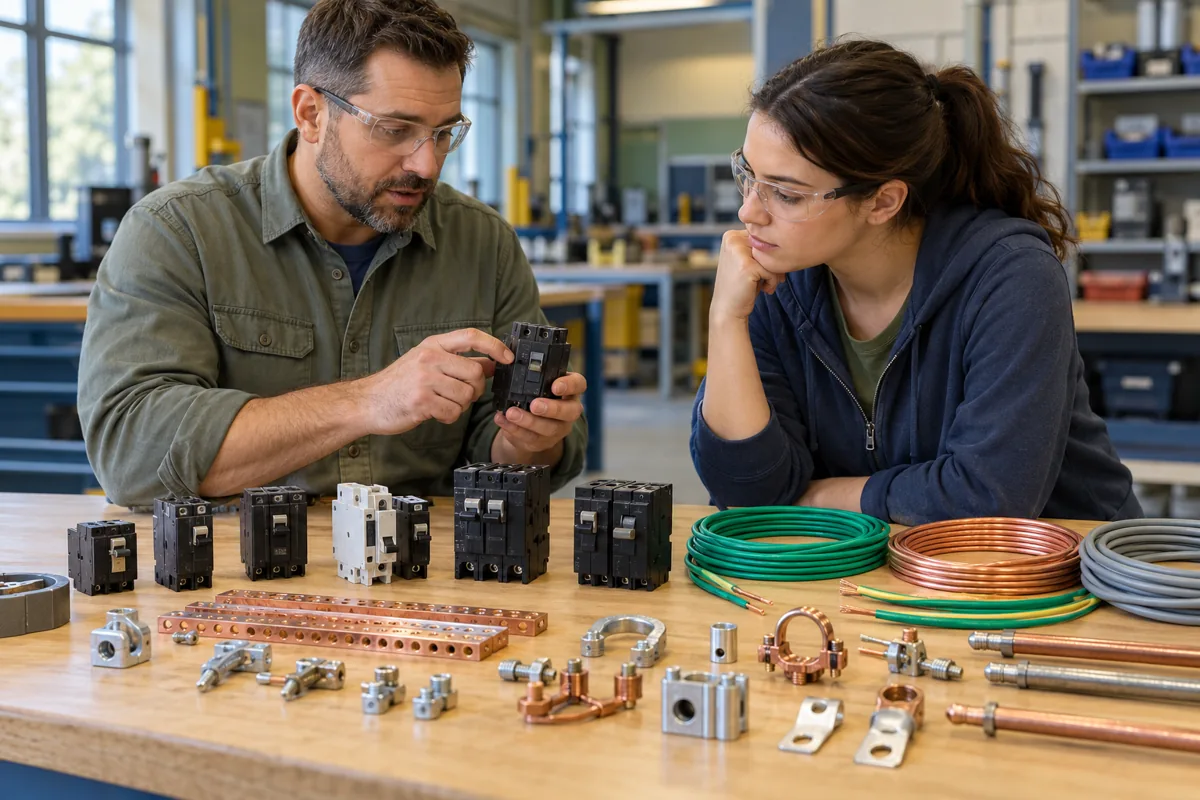
Learning goals
- Separate the concepts
- Protection has limits
- Avoid universal assumptions
Separate the concepts
Grounding and bonding have related but distinct purposes in an electrical system. Bonding supports continuity between conductive parts; grounding connects designated system points as required by the design and rules.
A neutral and an equipment grounding conductor are not casual substitutes for each other. Do not infer permitted connections from a simplified browser model or wire color alone.
Protection has limits
Overcurrent devices respond to current conditions according to their characteristics. Ground-fault protection responds to a different kind of condition. One protective function does not replace all others.
Repeated trips are a warning to investigate through qualified procedures, not a reason to install a larger protective device or defeat it. Protective ratings must fit the actual system requirements.
Avoid universal assumptions
Conductor sizing depends on more than a current number: installation conditions, conductor and insulation characteristics, load rules, terminals, and applicable code matter. This course does not provide a sizing table.
Recognize the need for current code, permits where applicable, approved equipment, and inspection. Your apprentice preparation goal is to ask and identify the correct process rather than memorize an unsafe shortcut.
Try the task
Explain why one calculation cannot size all real conductors.
Incomplete
7Meters and supplied readings
Learn measurement logic without practicing live testing.Locked — complete previous lessons
Meters and supplied readings
Learn measurement logic without practicing live testing.
Learning goals
- Choose the quantity
- Interpret resistance carefully
- Check consistency
Choose the quantity
A measurement must match the intended quantity and unit. Voltage, current, and resistance use different relationships and methods. An instrument’s appearance is not proof its rating or leads suit a task.
The workbench provides calculated virtual readings. It does not train energized probe placement. Real measurement requires qualified instruction, suitable rated equipment, and the applicable safe procedure.
Interpret resistance carefully
Resistance or continuity observations require the correct safe and isolated condition in actual work. Connected components can create alternate paths and misleading results.
An open path and a short are different findings, and neither should be inferred from an unexplained display alone. Verify units, range, model assumptions, and where the reading applies.
Check consistency
In an ideal series circuit, current is the same through each resistor and voltage drops add to the source. In parallel, branch voltages match and branch currents add.
Use these relationships to catch calculation mistakes. If a real measurement seems inconsistent, stop and verify the method with a qualified supervisor instead of repeating hazardous tests until a preferred number appears.
Try the task
Name three things a reading should include.
Incomplete
8Trade math, units, and drawing scales
Practice the calculations used in entry preparation.Locked — complete previous lessons
Trade math, units, and drawing scales
Practice the calculations used in entry preparation.
Learning goals
- Work with formulas
- Convert lengths and scales
- Separate power and energy
Work with formulas
Identify the known values and the requested quantity. Write the formula, substitute compatible units, calculate, then label the result. A correct number with the wrong unit is not a correct report.
For 24 V and 8 Ω, I = 3 A. For 12 V and 2 A, P = 24 W. Round only at the end when practical. Explain assumptions so the next person can check your work.
Convert lengths and scales
One foot equals 12 inches. A supplied drawing scale of 1 inch = 4 feet turns a 3-inch route into 12 feet. The printed scale and actual revision must be verified before relying on it.
A drawing resized on a phone or printer may not preserve measurable scale. Use stated dimensions when available and do not treat this course’s diagram as a construction drawing.
Separate power and energy
A 100 W fictional load running for 4 hours uses .4 kWh: 100/1000 × 4. A material allowance of 10% on 40 feet gives 44 feet.
These are planning exercises, not real installation specifications. Energy tariffs, operating duty, material requirements, and design details may change the actual result.
Try the task
Convert 5 feet to inches and add a stated 10% estimating allowance to 40 feet.
Incomplete
9Troubleshooting and safe handoff
Use evidence to decide what comes next.Locked — complete previous lessons
Troubleshooting and safe handoff
Use evidence to decide what comes next.
Learning goals
- Define and narrow the fault
- Predict before changing
- Make the handoff useful
Define and narrow the fault
Ask what should happen, what actually happens, and what changed. Determine whether one load, one branch, or a larger system is affected. Use safe observations and the approved task scope.
Do not assume a fuse, conductor, or load is bad because a device does not operate. A control setting, open path, failed component, or supply issue may produce similar symptoms.
Predict before changing
In the virtual bench, select an open fault and predict zero current. Reset, close the virtual switch, and compare the result. Change one setting at a time and record its effect.
Real troubleshooting uses qualified procedures and appropriate isolation or testing authorization. Do not recreate faults, bypass interlocks, or repeatedly reset protections to obtain evidence.
Make the handoff useful
Document the symptom, location, safe observations, supplied readings, changes within authorization, and unresolved concerns. State what is suspected rather than presenting a guess as confirmed.
Escalate when the work exceeds your status or training. A clear handoff protects others from repeating assumptions and supports continuity even when you are not authorized to make the repair.
Try the task
Write a short handoff for an intermittent failure you cannot safely reproduce.
Incomplete
10Jobsite communication and apprenticeship readiness
Prepare to learn reliably with others.Locked — complete previous lessons
Jobsite communication and apprenticeship readiness
Prepare to learn reliably with others.
Learning goals
- Be a dependable learner
- Build honest evidence
- Plan the next step
Be a dependable learner
Read the task, repeat key instructions, ask about limits, and report obstacles early. Reliable attendance and respectful communication matter alongside math. Do not hide uncertainty to appear experienced.
A supervisor needs to know when a drawing, material, or observed condition differs from the plan. Good questions name the mismatch and ask for clarification rather than proposing unauthorized changes.
Build honest evidence
Save practice calculations and explain one mistake you corrected. Describe a virtual circuit’s behavior and a stop-work decision. These examples show learning habits without claiming real installation experience.
List independent preparation separately from official credentials. Do not claim approved training hours, an apprenticeship completion, or electrician certification from LifeHelper.
Plan the next step
Contact a registered apprenticeship or appropriate approved school, verify current entry requirements, and ask about supervised work and financial commitments. The California DIR and Apprenticeship.gov links are starting points.
This course introduces foundations; actual electrical competence requires substantial supervised practice, current code instruction, employer procedures, and any required registration or certification.
Try the task
Write a truthful résumé learning entry.
Incomplete
Reference resources and next steps
Course content reviewed October 2026. Training requirements, products, and procedures vary; check the current official instructions.
California electrician certification and trainee informationOSHA electrical safetyCalifornia registered apprenticeship programsU.S. apprenticeship opportunitiesOSHA: control of hazardous energyThis is independent educational preparation, not approved apprenticeship hours, a license, an official exam, or authorization to work on real equipment. Browser models simplify physical behavior. Real tasks require applicable requirements, employer procedures, qualified supervision, and hands-on training.