Cosmetology Foundations & School Prep
Build your foundation before beauty school
Study hair, skin, nails, client care, and salon safety through complete lessons, fictional service decisions, visual theory labs, and practice exams. Arrive at formal training with better vocabulary, questions, and study habits.
Learn the foundations, one lesson at a time
Read each lesson, try its task, and pass the knowledge check to complete it automatically. You can practice or take an exam at any time.
11. Choosing a school and understanding the profession
Understand training routes, credentials, and how to compare schools.
1. Choosing a school and understanding the profession
Understand training routes, credentials, and how to compare schools.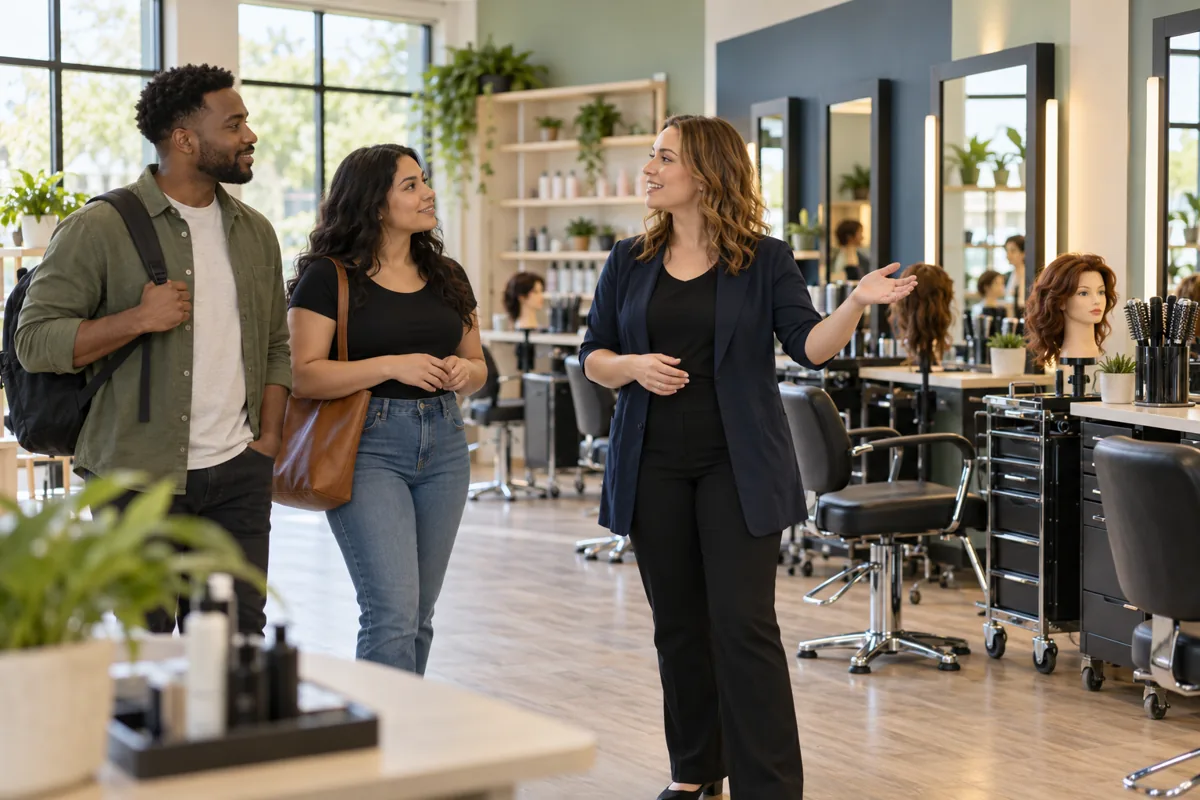
Learning goals
- Understand training routes, credentials, and how to compare schools.
- Explain the decision using the lesson principles.
- Apply the concept to a fictional case before supervised practice.
What cosmetology covers
Cosmetology brings together hair services and, within local scope, skin and nail services. A salon professional combines technical skill with hygiene, communication, observation, and sound decisions. Creativity matters, but a beautiful result cannot compensate for an unsafe service.
A cosmetology license is different from a school diploma, a manufacturer course, or an independent online completion record. Requirements differ by state. Ask the regulator which program and route qualify you before committing money.
Compare the learning experience
Use Milady Standard Cosmetology and Pivot Point Fundamentals as examples of established school curricula, not as a ranking of schools. Milady offers textbook and CIMA learning options; Pivot Point emphasizes structured theory, design, and workshops. Ask each school which edition and materials it teaches and whether demonstrations are included.
Tour the student clinic. Ask how instructors supervise services, how students practice on different hair textures, how feedback is given, and what happens after a failed skill assessment. An attractive building does not establish quality.
Before you enroll
Request the total written cost, kit list, attendance rules, refund terms, clinic schedule, and published completion and licensing outcomes. Clarify whether quoted outcomes apply to your program and year. Compare commute and work responsibilities against required attendance.
This foundation course is preparation for school. It does not provide approved hours, clinical competence, or permission to perform regulated services. Study terminology here and learn hands-on procedures under a qualified instructor.
Try the task
Write five questions you would ask during a school tour.
Incomplete
22. Consultation, consent, and service records
Turn a vague request into an agreed and documented plan.Locked — complete previous lessons
2. Consultation, consent, and service records
Turn a vague request into an agreed and documented plan.
Learning goals
- Turn a vague request into an agreed and documented plan.
- Explain the decision using the lesson principles.
- Apply the concept to a fictional case before supervised practice.
Ask before recommending
Start with the desired result, daily routine, previous services, relevant sensitivities, and budget. Ask open questions: What do you like about this picture? What upkeep feels realistic? Listen without criticizing the current style.
A photograph can show shape and color goals but cannot reveal hair history, lighting, or editing. Describe what is achievable today, what requires later appointments, and what remains uncertain.
Consent is specific
Explain the proposed service, cost, limitations, maintenance, and alternatives in plain language. Confirm understanding by asking the client to summarize the plan. Ask before touching, taking photos, or changing the agreed service.
A client may pause or refuse. Avoid pressuring them because a deposit was paid. Follow school policy for minors, interpreters, disability accommodations, and written consent; do not assume consent from silence.
Keep useful records
Record objective observations, relevant disclosed history, agreed goals, products and tests under instructor direction, and aftercare. Distinguish what the client said from what you observed. Keep records secure and share only for a legitimate purpose.
Do not record insulting judgments or unnecessary medical details. For this online practice, use fictional clients. In school, follow the approved record system rather than storing customer information on a personal phone.
Try the task
Draft a three-sentence consultation note for a fictional client.
Incomplete
33. Infection pathways and hand hygiene
Understand contamination and interrupt its spread.Locked — complete previous lessons
3. Infection pathways and hand hygiene
Understand contamination and interrupt its spread.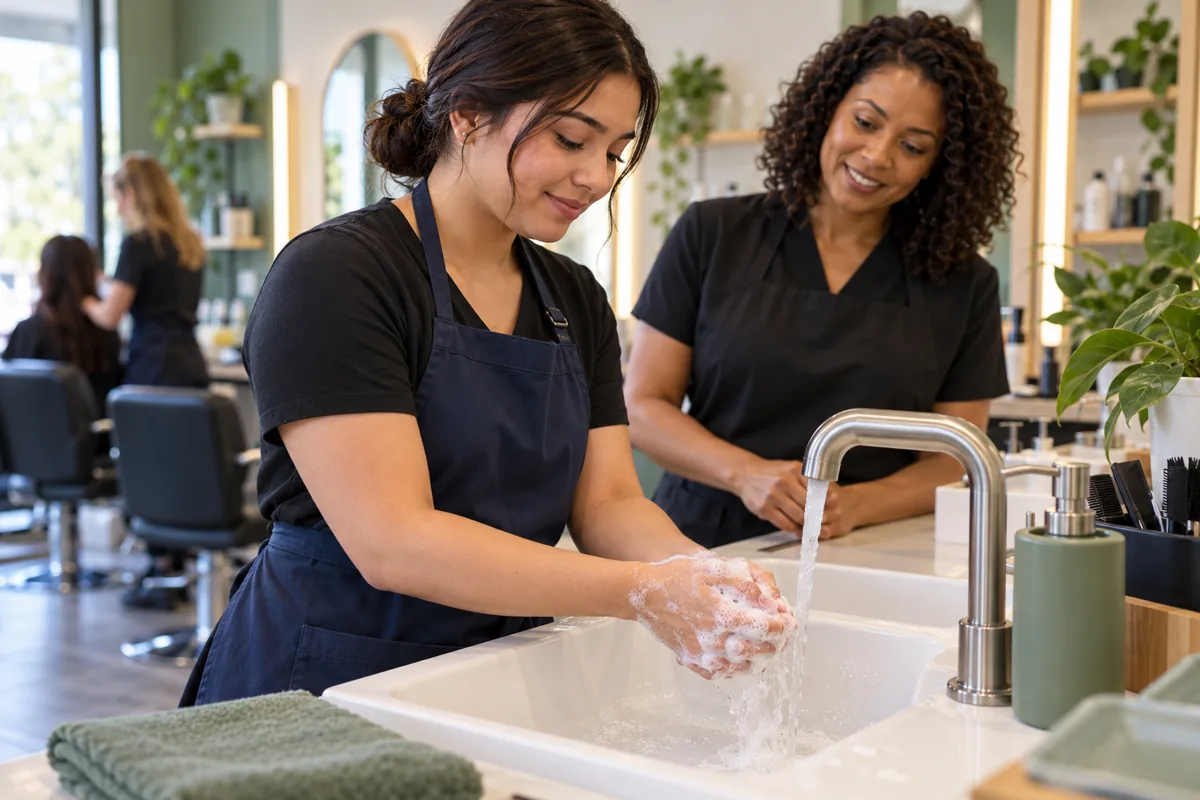
Learning goals
- Understand contamination and interrupt its spread.
- Explain the decision using the lesson principles.
- Apply the concept to a fictional case before supervised practice.
Follow the pathway
Microorganisms can move from a person or contaminated surface to hands, tools, or another client. A tool may look clean while still being contaminated. Think in terms of source, transfer, and opportunity rather than judging someone by appearance.
A phone, drawer handle, and clean comb can become linked by the same hands. Keep a clean zone separate from used tools and waste. If an item falls or touches a contaminated surface, stop treating it as ready to use.
Hands and barriers
Perform hand hygiene at appropriate transitions and when hands are dirty. Gloves are a task-specific barrier, not permission to touch every surface. Replace contaminated gloves and follow the school hygiene protocol before the next clean task.
Do not reuse single-use gloves or wash them for another client. Avoid touching a phone in working gloves. Select protection for the task and product instructions; one glove material is not suitable for every chemical.
Plan a safe station
Prepare only the supplies needed, with clean linens and covered clean storage. Keep used items in the designated dirty container. Clean and disinfect reusable contact surfaces between clients according to applicable rules and labels.
When you are unsure whether an item was processed, treat its status as unknown and reprocess correctly. A tidy station supports safety, but visual tidiness alone does not prove disinfection.
Try the task
Trace a possible contamination chain involving a phone and comb.
Incomplete
44. Cleaning, disinfection, and contact time
Choose the correct process for the tool and read the product label.Locked — complete previous lessons
4. Cleaning, disinfection, and contact time
Choose the correct process for the tool and read the product label.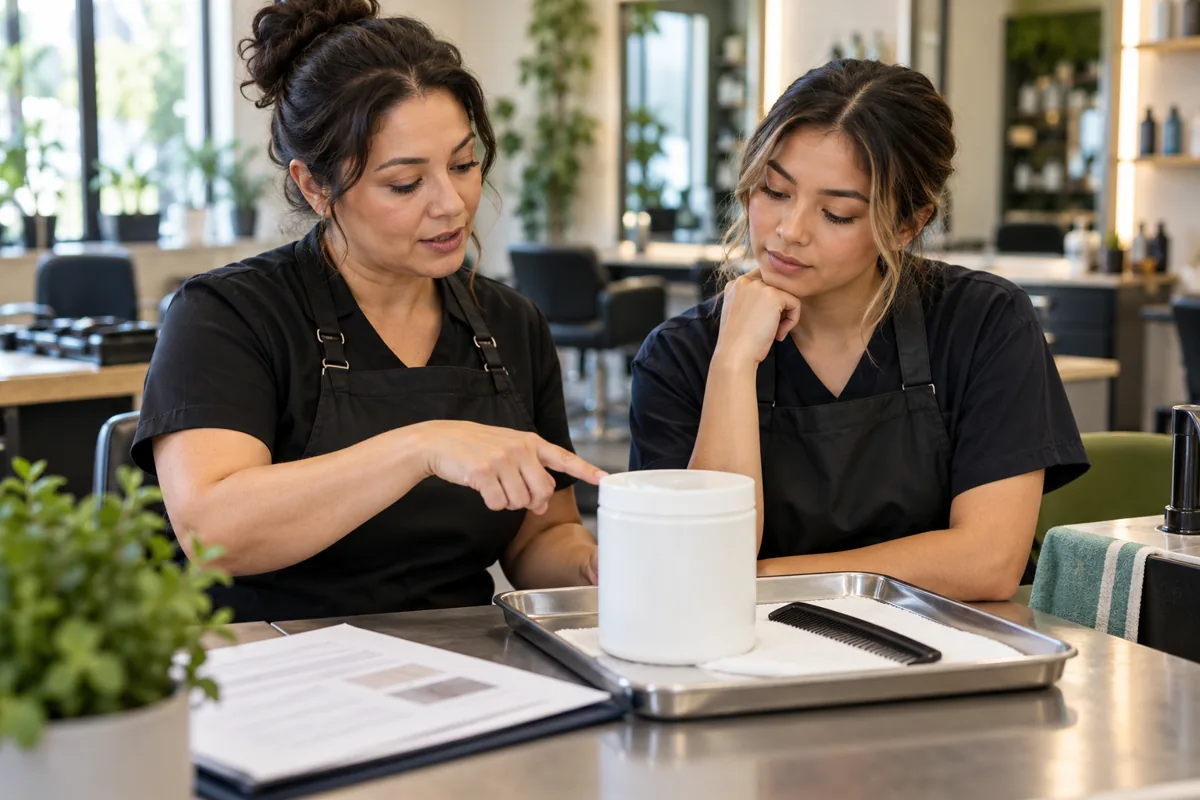
Learning goals
- Choose the correct process for the tool and read the product label.
- Explain the decision using the lesson principles.
- Apply the concept to a fictional case before supervised practice.
Different purposes
Cleaning removes soil and debris. Disinfection uses an appropriate product to reduce specified microorganisms on suitable surfaces. Sterilization is a separate validated process; do not describe an ordinary disinfectant jar as a sterilizer.
Soil can interfere with processing. Identify the tool material and type before selecting a method. Porous single-use supplies, electrical tools, and immersible non-electrical tools do not share one universal procedure.
Use the right instructions
For California immersible non-electrical tools other than shears, review the Board sequence: remove debris, wash with soap or detergent and water, dry, then completely immerse in the specified EPA-registered disinfectant following its directions.
Shears and electrical tools have different rules. Never immerse a powered tool because a comb can be immersed. Read the tool manual, disinfectant label, and local requirements together, including compatibility and disposal.
Time is part of the process
Contact time is the period the surface must remain exposed as directed. A quick dip is not equivalent to the required time. Prepare solutions and monitor replacement according to the label; do not improvise concentration or mix chemicals.
After completing the correct process, follow required removal, rinsing, drying, and clean storage instructions. If you cannot verify the concentration or time, do not release the tool as ready.
Try the task
Explain why cleaning and contact time are both necessary.
Incomplete
55. Single-use supplies, linens, and incidents
Prevent reuse and respond to an unexpected safety problem.Locked — complete previous lessons
5. Single-use supplies, linens, and incidents
Prevent reuse and respond to an unexpected safety problem.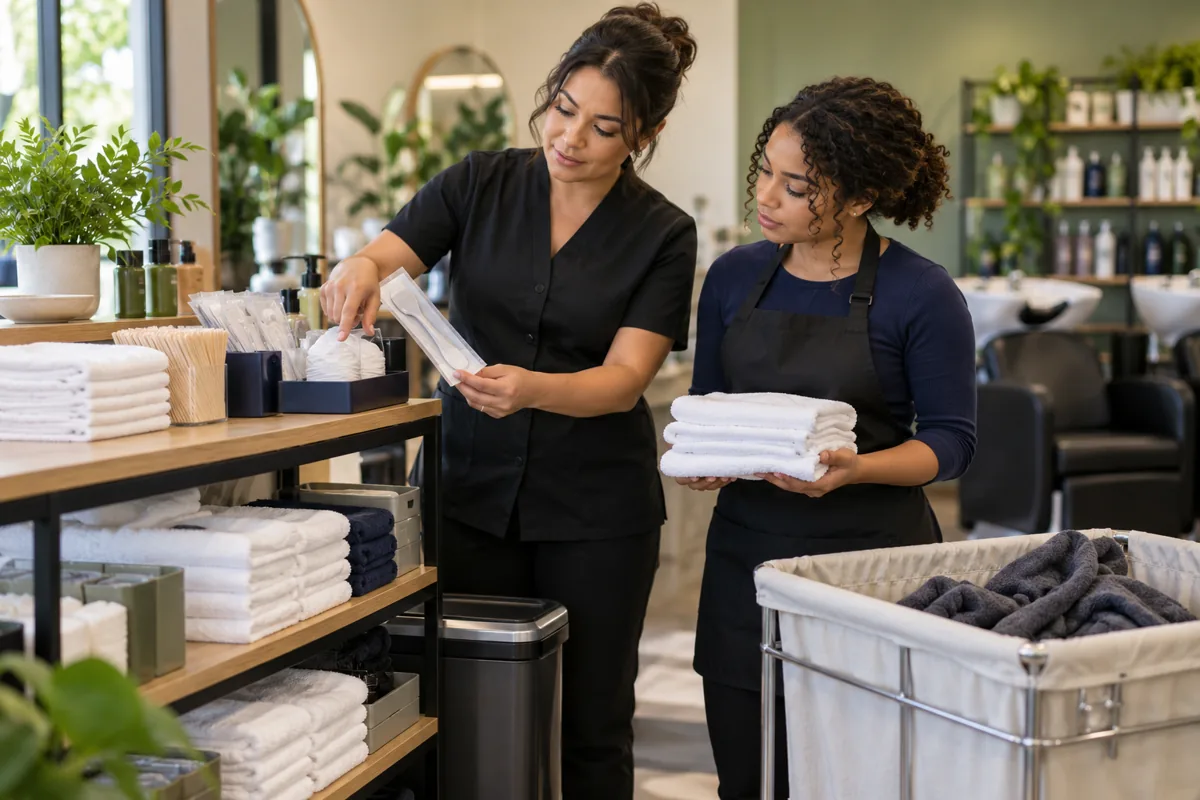
Learning goals
- Prevent reuse and respond to an unexpected safety problem.
- Explain the decision using the lesson principles.
- Apply the concept to a fictional case before supervised practice.
One client means one client
Supplies that cannot be properly disinfected must not be reused between clients. Recognize porous files, cotton, neck strips, applicators, and other designated single-use materials. A storage bag with a client name does not make a contaminated disposable suitable for reuse.
Protect bulk product by using the permitted dispensing method. Never return a used applicator to a shared container. Set out enough new supplies before beginning so convenience does not drive unsafe decisions.
Laundry and workspace
Use fresh properly laundered linens and keep clean linens protected from used ones. Follow school procedures for handling soiled laundry. Do not let a used towel become the surface for disinfected tools.
Clean equipment and furniture using the method appropriate to the surface. A disposable basin liner does not automatically remove equipment-cleaning responsibilities. Footspa procedures and logs depend on the equipment and local rules.
Stop and get help
For a cut, exposure, spill, or sudden reaction, stop the service, alert the instructor, and follow the emergency and exposure procedure. Use the product safety information and trained assistance rather than improvising treatment.
Protect privacy while documenting facts and actions. Difficulty breathing, collapse, or another severe emergency requires immediate emergency assistance. Do not continue a service simply to finish on schedule.
Try the task
List three items to separate after a service.
Incomplete
66. Product labels, SDS, ventilation, and ergonomics
Learn how to find safety information and protect yourself at work.Locked — complete previous lessons
6. Product labels, SDS, ventilation, and ergonomics
Learn how to find safety information and protect yourself at work.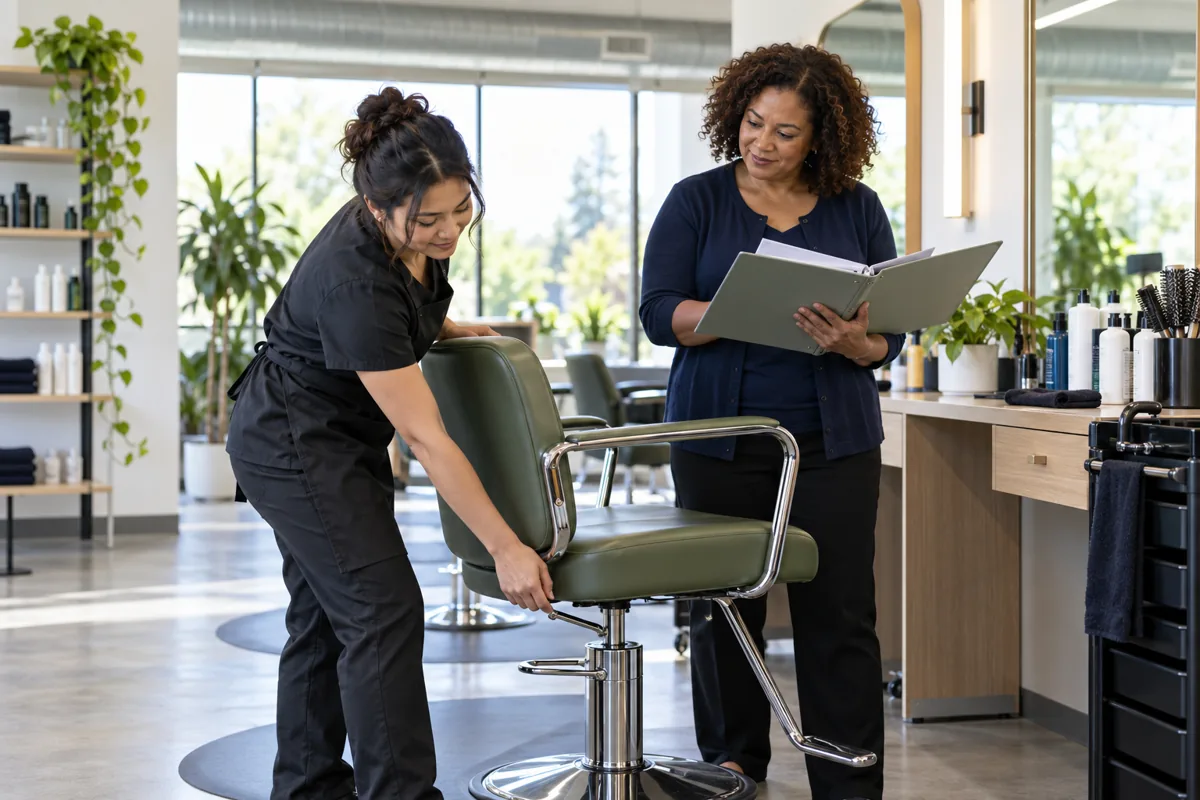
Learning goals
- Learn how to find safety information and protect yourself at work.
- Explain the decision using the lesson principles.
- Apply the concept to a fictional case before supervised practice.
Read two different documents
The label identifies intended use, warnings, and directions. A safety data sheet (SDS) describes hazards, exposure controls, handling, and emergency information. Locate both before working with an unfamiliar product. Marketing terms are not a substitute.
Never guess a dilution, processing time, or chemical compatibility from another brand. Keep containers labeled and closed. Ask an instructor to clarify missing or conflicting instructions before the service.
Control exposure
Ventilation helps control airborne vapors and dust at their source. A pleasant fragrance does not prove safe air, and an ordinary dust mask does not filter chemical vapors. Employers must choose appropriate controls and any required respiratory protection program.
Use task-appropriate protection and avoid unnecessary skin contact. Keep food away from chemical work areas. If irritation or illness occurs, report it and follow the safety plan rather than becoming accustomed to symptoms.
Work comfortably
Raise or lower the chair to reduce bending and keep supplies within comfortable reach. Alternate tasks and use brief recovery breaks where possible. Grip tools without excessive force and keep the wrist closer to a neutral position.
Persistent pain is a reason to seek help, not a requirement of the career. Learn safe electrical-tool handling, keep liquids away from incompatible powered equipment, and report damaged cords or overheating devices.
Try the task
Write where you would find hazard and first-aid information.
Incomplete
77. Hair structure and growth
Connect hair anatomy to what a stylist observes.Locked — complete previous lessons
7. Hair structure and growth
Connect hair anatomy to what a stylist observes.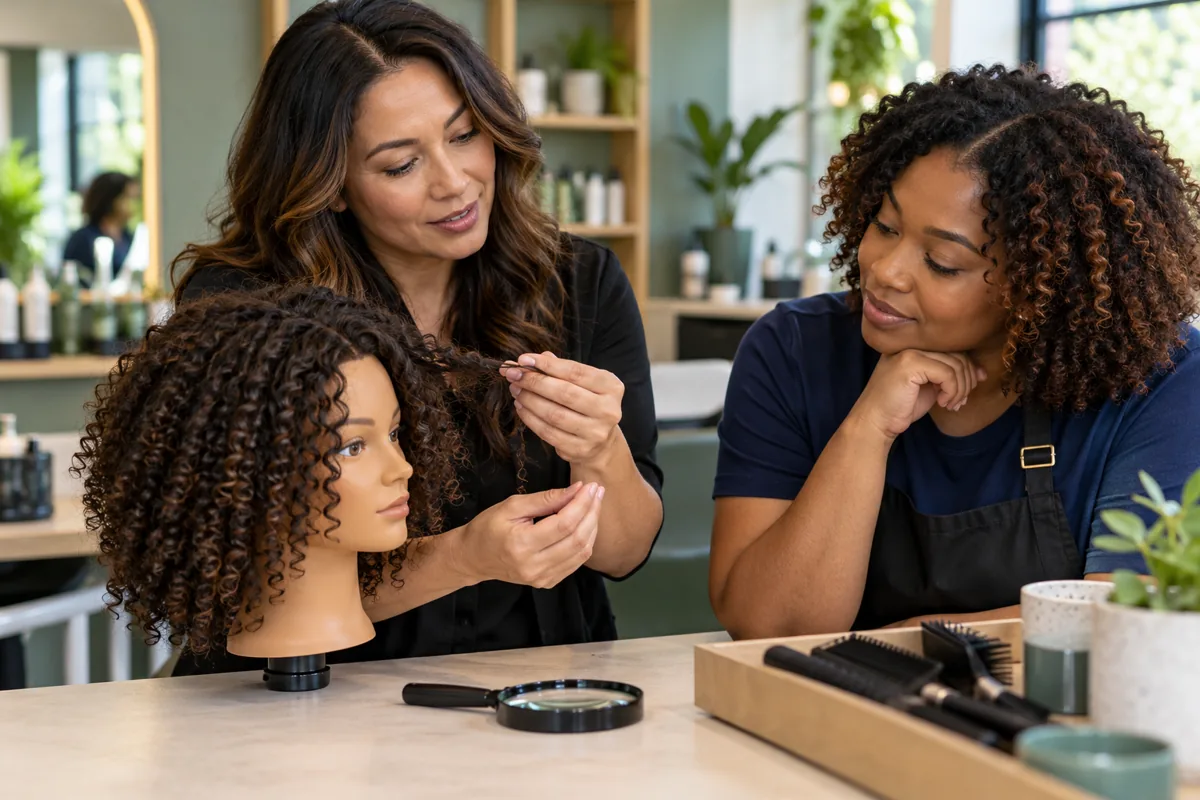
Learning goals
- Connect hair anatomy to what a stylist observes.
- Explain the decision using the lesson principles.
- Apply the concept to a fictional case before supervised practice.
The visible fiber
The hair shaft is a keratinized fiber. The cuticle is the outer protective layer; the cortex contains much of the fiber structure and pigment. Some hair has a medulla, but its presence is variable. A damaged shaft cannot heal like living skin.
Conditioners can improve feel and reduce friction, but this is not permanent biological repair. Repeated heat, friction, and chemical stress can weaken a fiber. Record damage instead of assuming one product will reverse it.
Growth is not breakage
Growth occurs within the follicle. Growth cycles vary, and hair visible above the skin is not the growth-producing tissue. A short broken strand and a shed strand are different observations, not diagnoses.
Unexpected shedding, scalp pain, or patchy loss should be brought to the instructor and, when appropriate, a healthcare professional. A stylist should not name a medical condition or promise to treat it.
Observe respectfully
Look at multiple areas because one head can contain different patterns and conditions. Describe the observations in everyday terms. Ask permission before examining and explain why the information affects service planning.
A preparation task can be a labeled sketch or comparison of fictional fibers. Hands-on scalp assessment and services belong in supervised training.
Try the task
Draw the outer cuticle and inner cortex of a strand.
Incomplete
88. Texture, density, porosity, and elasticity
Use separate observations instead of stereotypes.Locked — complete previous lessons
8. Texture, density, porosity, and elasticity
Use separate observations instead of stereotypes.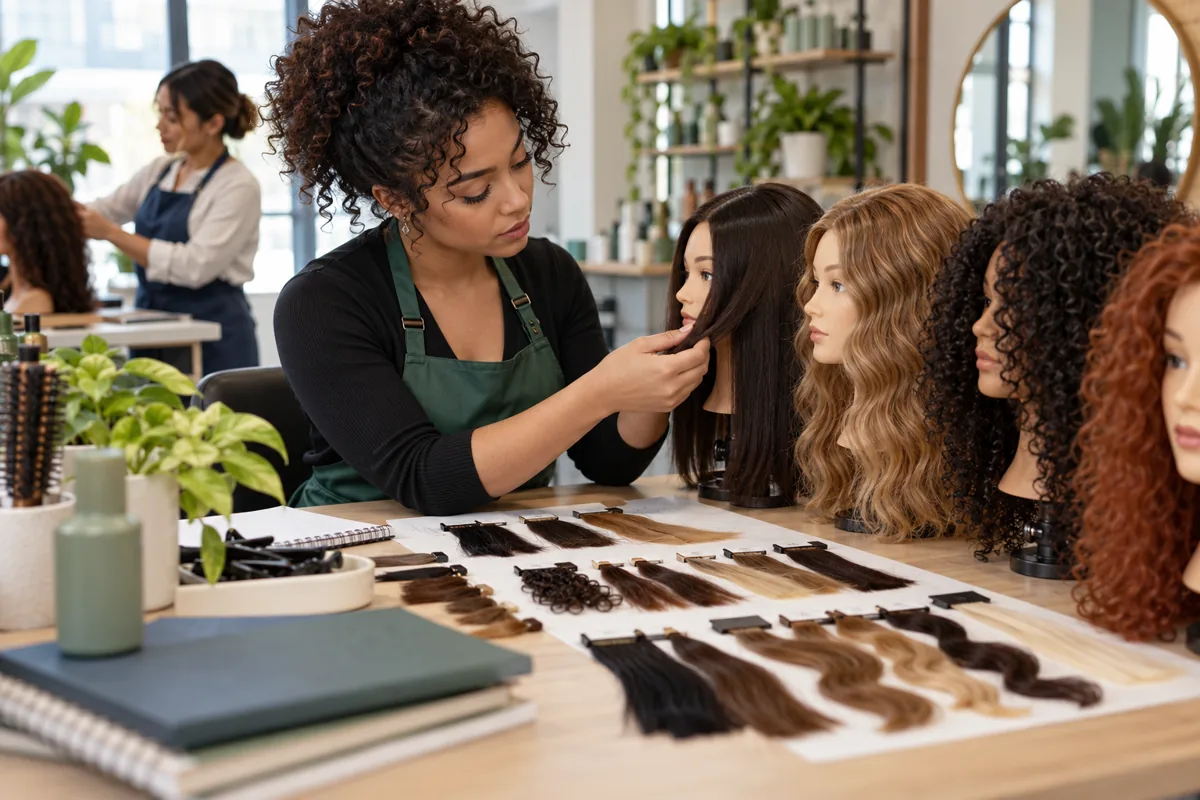
Learning goals
- Use separate observations instead of stereotypes.
- Explain the decision using the lesson principles.
- Apply the concept to a fictional case before supervised practice.
Different measurements
Texture can refer to strand thickness in school terminology; curl pattern describes the shape of the fiber. Density describes how many strands occupy an area. A person can have fine strands and high density, or coarse strands and low density.
Do not infer these properties from ethnicity. Observe the individual head and use the terminology taught by your program. Several patterns may coexist, so plan section size and handling accordingly.
Porosity and elasticity
Porosity describes how readily the fiber takes up and retains moisture or product. Elasticity concerns how a strand stretches and returns without breaking. These observations influence the instructor’s assessment of service suitability.
Porosity is not established reliably by a single social-media float test. Product buildup, treatments, and damage can affect observations. Use the school’s supervised assessment rather than pulling aggressively or choosing chemicals from one clue.
Translate observations into a plan
Fragile ends call for gentle handling and realistic expectations. Dense hair may need smaller organized sections. Curl shrinkage affects apparent length and the discussion about the finished result.
Document observations separately: fine strands, dense distribution, defined curls, fragile ends. This is more useful than writing difficult hair. Ask the client about previous experiences and preferences.
Try the task
Write four separate observations for a fictional head of hair.
Incomplete
99. Shampooing, conditioning, and detangling theory
Plan comfort, gentle handling, and product selection.Locked — complete previous lessons
9. Shampooing, conditioning, and detangling theory
Plan comfort, gentle handling, and product selection.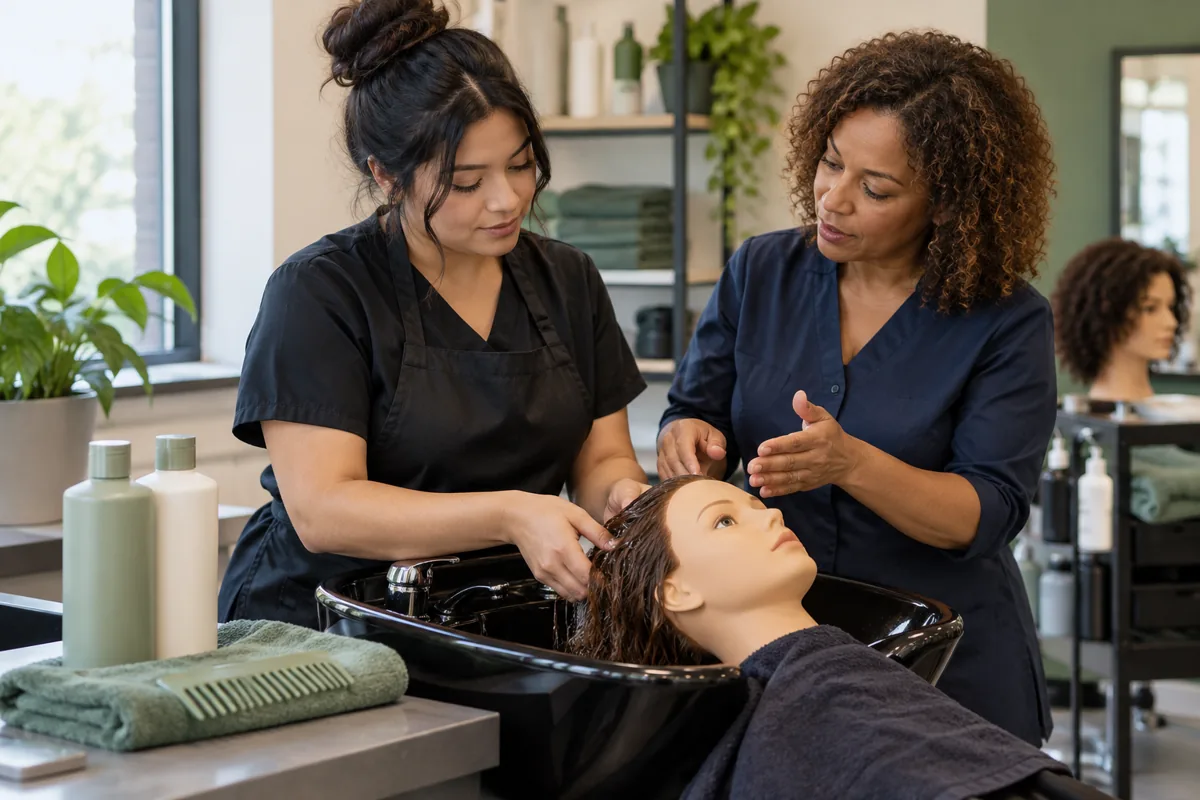
Learning goals
- Plan comfort, gentle handling, and product selection.
- Explain the decision using the lesson principles.
- Apply the concept to a fictional case before supervised practice.
Prepare for comfort
A school shampoo service starts with consultation, appropriate draping, and safe positioning at the basin. Check comfort and water temperature with the client. Protect their clothing and avoid directing water into the eyes or ears.
Use a product chosen for the observed hair and the labeled purpose, not just fragrance. Product claims such as moisturizing or clarifying should be interpreted alongside history, buildup, and sensitivity information.
Cleanse without force
Organize hair so cleansing and rinsing are controlled. Do not use nails to scratch the scalp or treat discomfort as normal. Follow the instructor’s method for scalp contact, especially when a condition makes service inappropriate.
Rinse thoroughly as directed and reassess comfort. More product does not automatically produce better cleaning. Learn how your school distinguishes routine cleansing from a service needing medical or instructor referral.
Condition and detangle
Conditioning can reduce friction and improve manageability. Detangling is gentler when you support the section, work carefully from the ends toward the root, and use a suitable tool. Adapt to texture and client preferences.
Avoid ripping through resistance or applying heavy tension to the scalp. If matting exceeds your training, pause and ask for an appropriate plan rather than turning a routine appointment into an unsafe struggle.
Try the task
Describe how you would discuss comfort at the shampoo basin.
Incomplete
1010. Sectioning and haircut design vocabulary
Learn guides, elevation, and overdirection before using cutting tools.Locked — complete previous lessons
10. Sectioning and haircut design vocabulary
Learn guides, elevation, and overdirection before using cutting tools.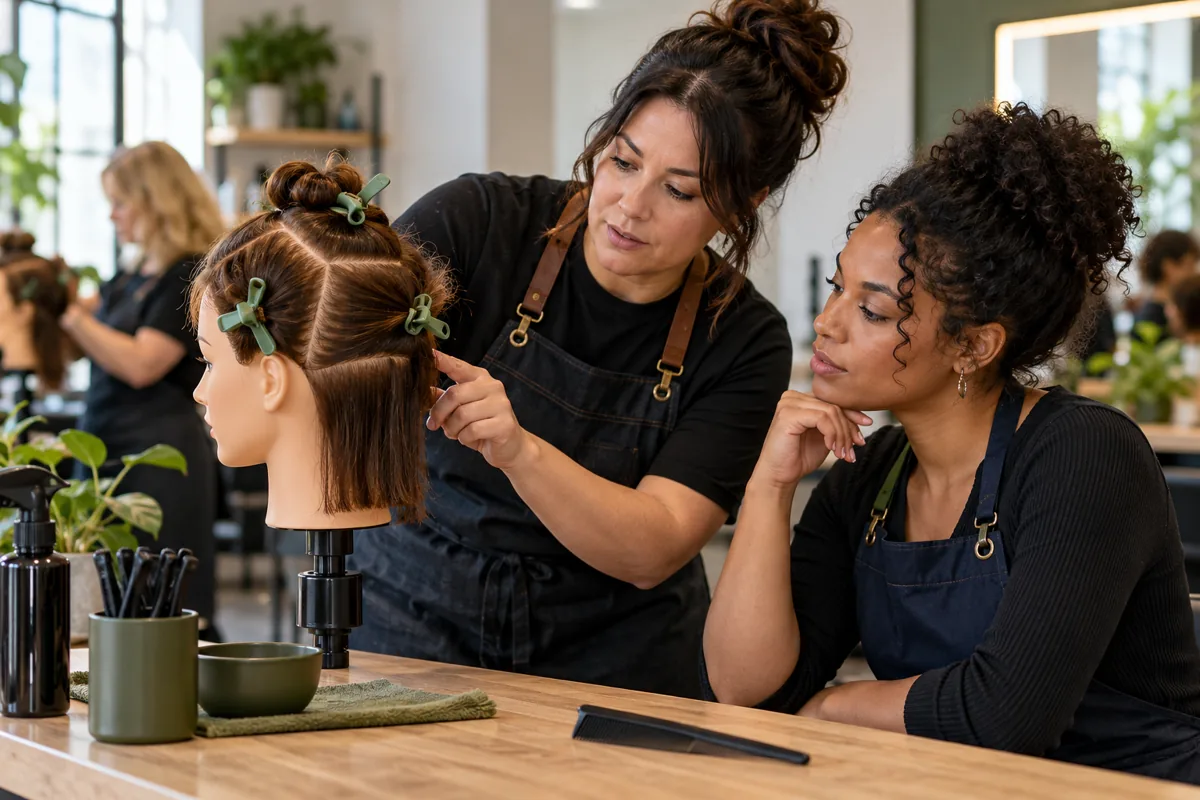
Learning goals
- Learn guides, elevation, and overdirection before using cutting tools.
- Explain the decision using the lesson principles.
- Apply the concept to a fictional case before supervised practice.
Organize before removing length
Sectioning divides hair into manageable areas and helps keep the intended plan consistent. A guide provides a length reference. A stationary guide stays in one reference location; a traveling guide moves as the work progresses.
Check balance and the agreed finished length before cutting. This online lesson uses diagrams and paper planning. Sharp-tool handling and actual cutting should be taught and supervised in school.
Elevation and distribution
Elevation describes how a section is lifted away from its natural fall. In simplified design theory, low elevation preserves more weight, while higher elevation can create more layering. Final results also depend on section direction and head shape.
Overdirection moves hair away from where it naturally falls before cutting. It can preserve length in selected areas. A number alone does not define a complete haircut; consult the guide, distribution, tension, and desired result.
Check the result
Cross-checking compares sections from a different direction to locate inconsistency. Do not keep removing length merely to chase an uncertain line. Stop and ask for feedback when the guide is lost.
Account for curl spring and head position. A cooperative consultation and systematic plan reduce misunderstandings more effectively than cutting quickly.
Try the task
On paper, label natural fall, a guide, and a lifted section.
Incomplete
1111. Styling, heat, and electrical-tool safety
Relate shape to moisture, heat, tension, and client comfort.Locked — complete previous lessons
11. Styling, heat, and electrical-tool safety
Relate shape to moisture, heat, tension, and client comfort.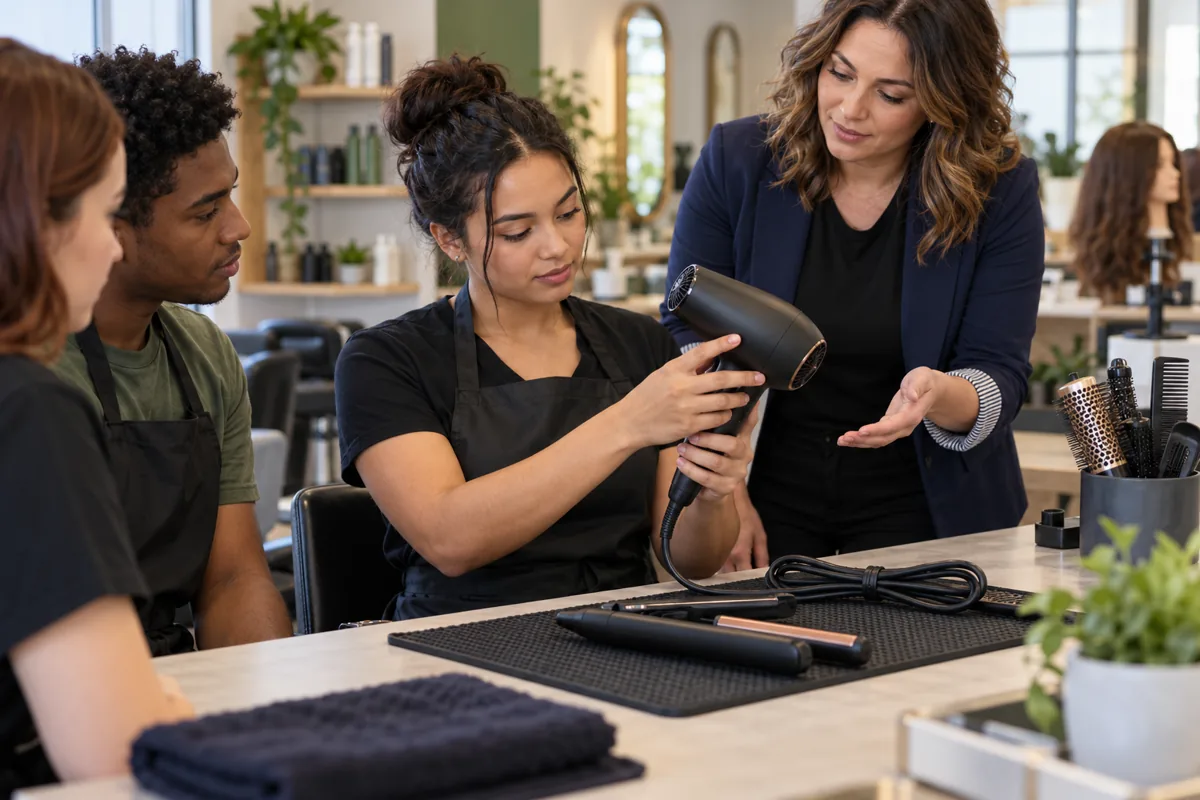
Learning goals
- Relate shape to moisture, heat, tension, and client comfort.
- Explain the decision using the lesson principles.
- Apply the concept to a fictional case before supervised practice.
Temporary shape
Water and styling can temporarily alter hair shape, while chemical texture services act differently. Temporary styling results depend on preparation, section size, direction, and finish. Understand the intended effect before choosing a tool.
A style plan should fit daily maintenance and hair condition. Ask about natural texture preferences and avoid presenting straight hair as a requirement for professionalism.
Control heat and tension
Use tools within manufacturer instructions and the instructor’s protocol. Select an appropriate setting for the situation rather than always using the highest heat. A protectant does not eliminate the risk of thermal damage.
Keep hot surfaces away from skin and maintain a safe rest position. Excessive repeated passes and tension can worsen damage. The client reporting burning or pulling is a reason to stop and reassess.
Check equipment
Inspect cords and devices before use. Keep incompatible powered equipment away from water. Switch off and safely store hot tools as instructed; never leave them where another person can touch an unprotected hot surface.
In a preparation course, practice reading the control labels and planning sections on paper. Do not attempt an unfamiliar powered tool technique on another person without school supervision.
Try the task
Write a pre-use tool checklist.
Incomplete
1212. Color theory: level, tone, and complementary colors
Separate brightness from hue and apply a conceptual color wheel.Locked — complete previous lessons
12. Color theory: level, tone, and complementary colors
Separate brightness from hue and apply a conceptual color wheel.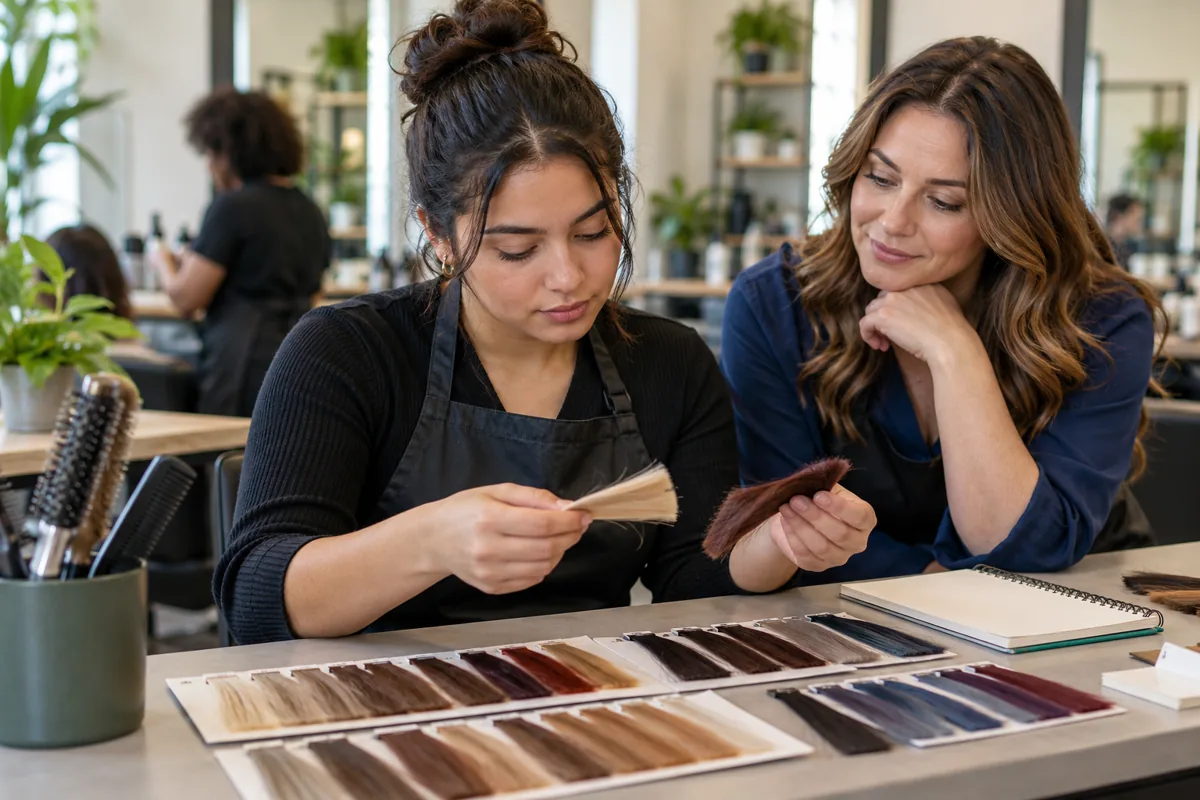
Learning goals
- Separate brightness from hue and apply a conceptual color wheel.
- Explain the decision using the lesson principles.
- Apply the concept to a fictional case before supervised practice.
Two different observations
Level describes relative lightness or depth in a color system; tone describes the color character, such as warm or cool. Numbering and names vary by manufacturer, so learn the chosen system rather than transferring numbers blindly.
Hair can show different levels along its length. Existing artificial color, natural pigment, porosity, and lighting can affect interpretation. One photo cannot establish a safe formula.
Use the wheel as a concept
On a simplified color wheel, violet is opposite yellow, blue is opposite orange, and green is opposite red. Opposing hues can reduce the appearance of an unwanted tone in a controlled formulation. This is a theory exercise, not a mixing recipe.
Neutralizing a tone does not by itself make the hair lighter or repair damage. The product system, starting condition, amount, and procedure matter. Your instructor teaches how theory becomes a supervised service.
Discuss realistic goals
A large color change may need a staged plan or may not be suitable. Explain limitations honestly and do not promise identical results from all starting colors. Record relevant chemical history and perform required tests under instruction.
Use the virtual wheel practice to match hues, not to choose developer strengths or processing times. Never mix real products based on a simulated answer.
Try the task
Write the three complementary pairs in this simplified model.
Incomplete
1313. Hair color history and required tests
Distinguish consultation, strand testing, and skin testing.Locked — complete previous lessons
13. Hair color history and required tests
Distinguish consultation, strand testing, and skin testing.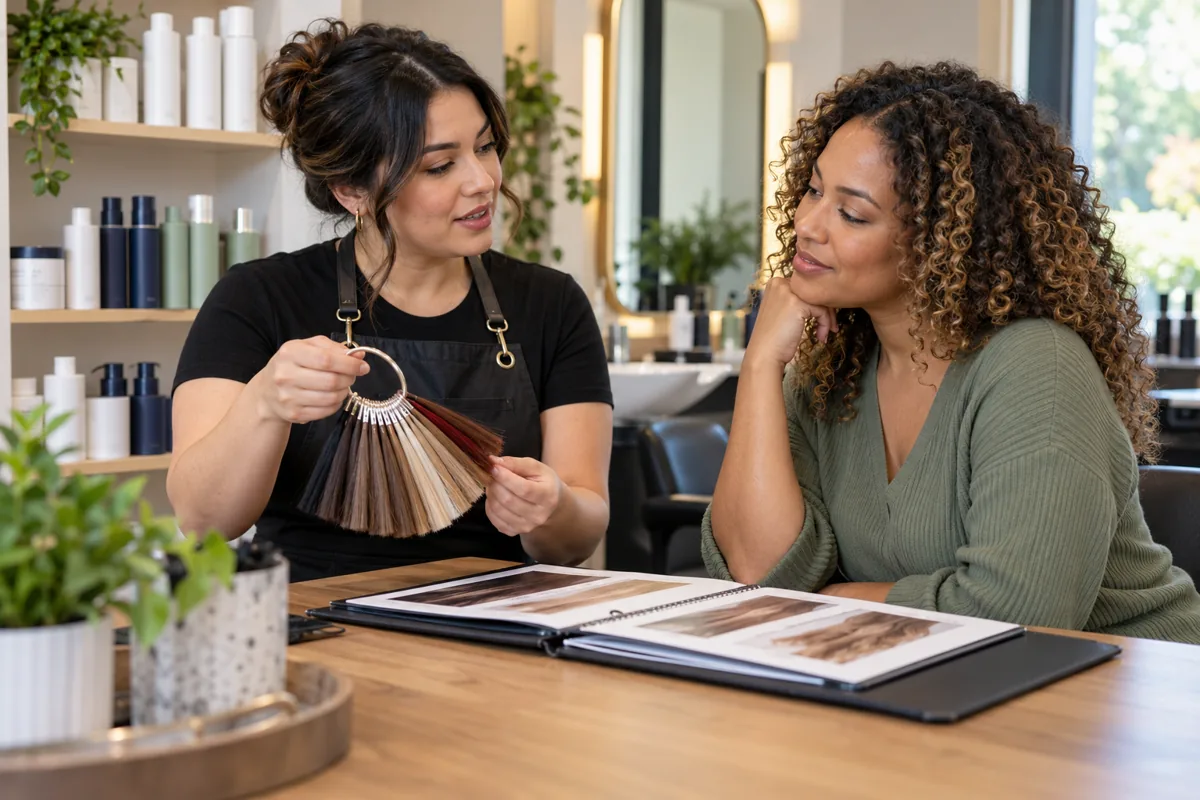
Learning goals
- Distinguish consultation, strand testing, and skin testing.
- Explain the decision using the lesson principles.
- Apply the concept to a fictional case before supervised practice.
History affects suitability
Ask about previous color, lighteners, texture services, reactions, and at-home products. Unknown history is a reason for instructor assessment, not a reason to guess. A strand can contain old chemical changes even when new growth looks healthy.
Record approximate dates and what the client knows without inventing product names. A corrective-color plan may take multiple sessions. Avoid guarantees when the starting condition is uncertain.
Tests answer different questions
A strand test helps assess the response of a small hair sample under the prescribed procedure. A skin or predisposition test addresses possible sensitivity according to the product instructions. One does not replace the other.
FDA advises following hair-dye instructions and skin testing before every use; a negative skin test does not guarantee no reaction. Prior reactions require careful professional assessment, not simply trying a smaller amount today.
Know when to defer
Scalp irritation, a concerning history, missing required testing, or product uncertainty can make a service inappropriate today. Explain the reason without blame and involve the instructor. Do not use scalp hair dye on eyelashes or eyebrows.
A client’s willingness to accept risk does not make an unsuitable service acceptable. Choose a safe alternative or reschedule when appropriate. This course provides no developer selection, mixing ratios, or chemical-processing recipes.
Try the task
Compare the purpose of a strand test and a skin test.
Incomplete
1414. Chemical texture and compatibility
Understand why waving and straightening require supervised assessment.Locked — complete previous lessons
14. Chemical texture and compatibility
Understand why waving and straightening require supervised assessment.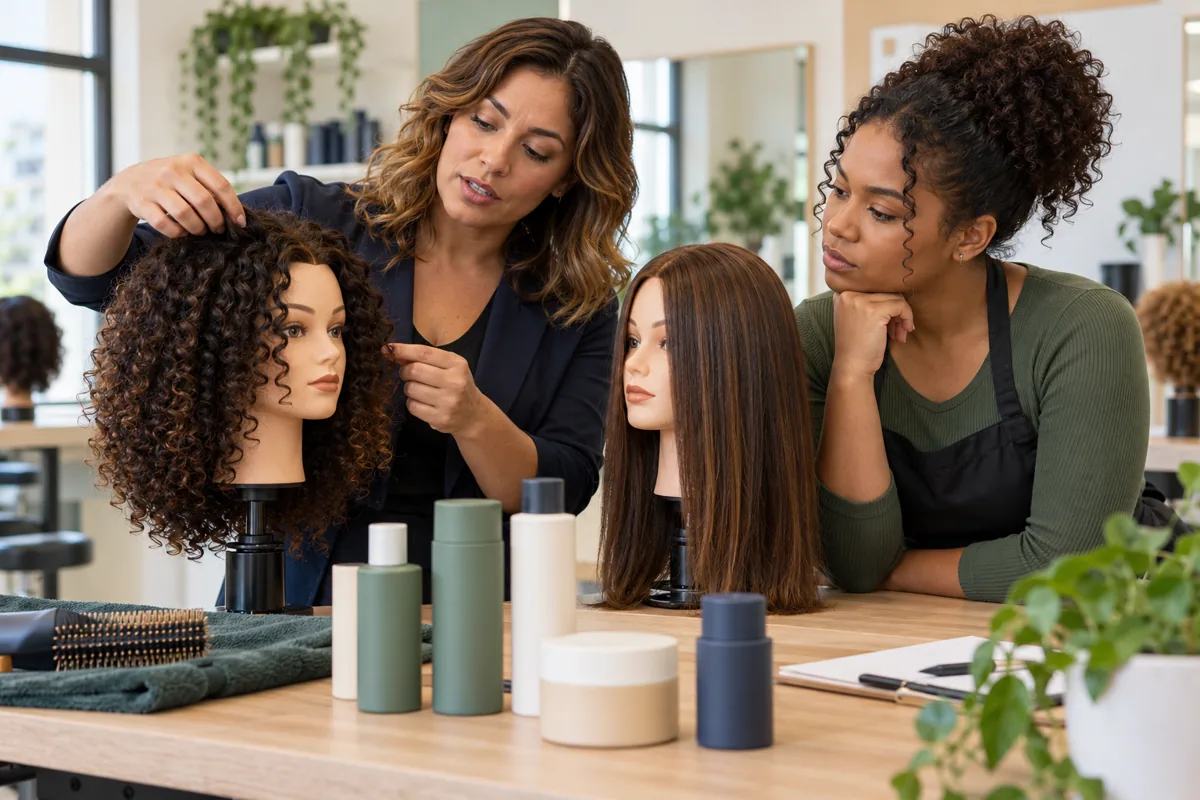
Learning goals
- Understand why waving and straightening require supervised assessment.
- Explain the decision using the lesson principles.
- Apply the concept to a fictional case before supervised practice.
Structure changes
Chemical texture services change the hair’s structure rather than only setting a temporary shape. Waving and straightening use different systems and may involve reducing, oxidizing, or other chemical processes. They are not interchangeable.
Prior services and current fiber condition affect suitability. New growth and previously treated lengths may respond differently, so repeating one treatment everywhere can create problems.
Compatibility is product-specific
Do not assume two products are compatible because both claim to straighten hair. Identify exact systems and follow manufacturer directions and instructor assessment. Unknown chemical history is a meaningful uncertainty.
Application, protection, processing, and any neutralizing step are taught hands-on at school. Skipping a system-required stage is not a way to save time. Online theory cannot establish safe technique on a real client.
Comfort is a safety signal
Burning, pain, unexpected breakage, or sudden reactions require stopping and following the safety procedure. Product handling and ventilation must be suitable for the system. Do not trust formaldehyde-free marketing alone as proof of no airborne hazard.
Discuss maintenance and the limits of the service. A nonchemical style may be a suitable alternative while history or hair condition is assessed. Never perform a demonstration chemical service at home for this course.
Try the task
Write a respectful explanation for postponing an uncertain service.
Incomplete
1515. Skin structure and observation boundaries
Recognize basic anatomy without diagnosing conditions.Locked — complete previous lessons
15. Skin structure and observation boundaries
Recognize basic anatomy without diagnosing conditions.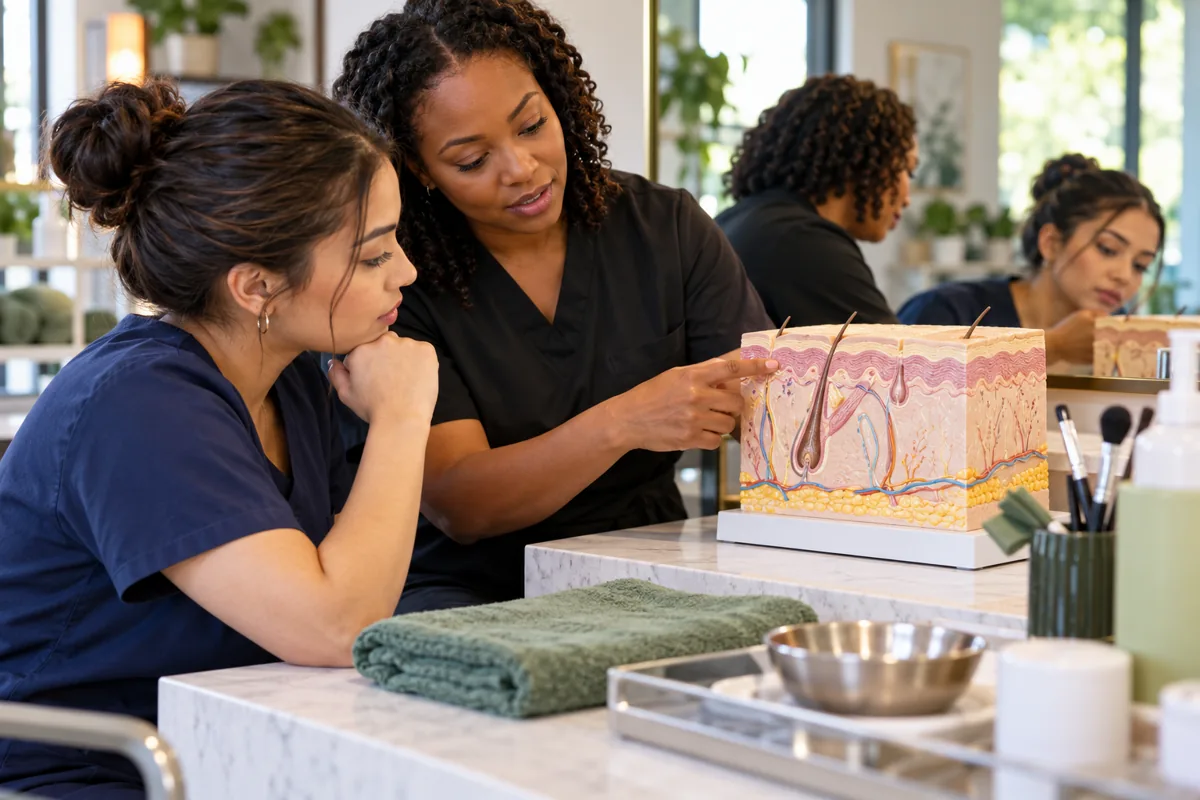
Learning goals
- Recognize basic anatomy without diagnosing conditions.
- Explain the decision using the lesson principles.
- Apply the concept to a fictional case before supervised practice.
A protective organ
The epidermis is the outer skin layer; the dermis contains supporting structures such as connective tissue, vessels, and nerves. Skin is a barrier with sensory and protective roles. Cosmetic services should respect that barrier.
Appearance varies across skin tones and lighting. Do not assume irritation always appears bright red. Ask about discomfort and observe changes relative to the person’s usual skin appearance.
Describe rather than diagnose
Dryness, visible irritation, broken skin, or an unusual spot are observations. They do not establish a disease. If a service could worsen a concern, pause and involve the instructor; recommend appropriate healthcare assessment when needed.
Do not attempt to remove, cover, or treat a suspicious lesion as a cosmetic problem. A licensed cosmetic scope is not permission to practice medicine or perform every advertised skin procedure.
Plan a suitable service
Consultation includes relevant product sensitivities and current treatments disclosed by the client. The school determines which information is needed for a service and how to protect it. Consent alone does not override contraindications.
For online practice, evaluate fictional descriptions and identify when more assessment is needed. Do not examine real people to diagnose a condition for a lesson.
Try the task
Rewrite “client has an infection” as an objective observation.
Incomplete
1616. Facial, hair-removal, and makeup foundations
Plan hygiene, suitability, and a client-centered finish.Locked — complete previous lessons
16. Facial, hair-removal, and makeup foundations
Plan hygiene, suitability, and a client-centered finish.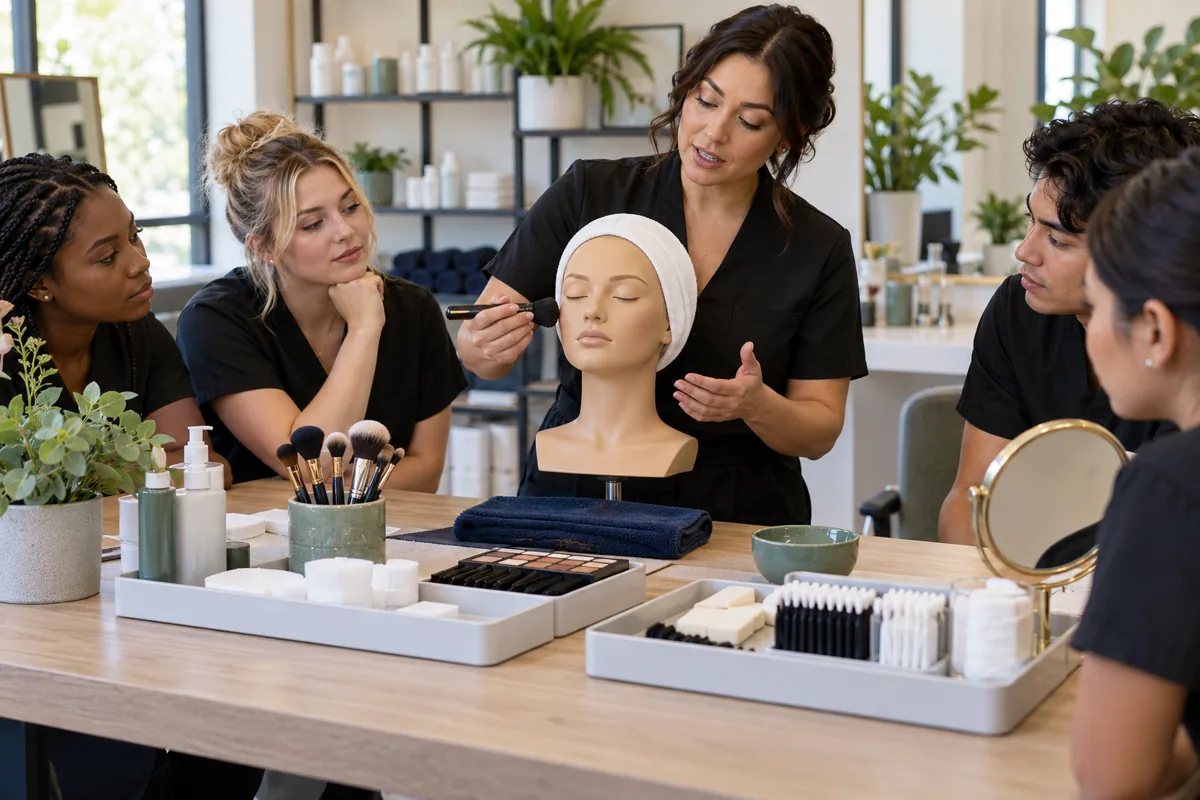
Learning goals
- Plan hygiene, suitability, and a client-centered finish.
- Explain the decision using the lesson principles.
- Apply the concept to a fictional case before supervised practice.
Facial-service sequence
A basic supervised facial begins with consultation and assessment, then uses an instructor-approved sequence of cleansing and suitable products. Product choice depends on the service purpose, skin condition, and labeled directions. More aggressive treatment is not automatically better.
Exfoliation, heat, devices, and other procedures can have contraindications. Learn the school’s scope and method instead of copying an online routine. This lesson teaches planning, not invasive or advanced procedures.
Hair-removal decisions
Ask about relevant treatments and medications according to the school protocol, including products that may increase skin sensitivity. Avoid working over broken, irritated, or otherwise unsuitable skin. Confirm that the method is within the permitted scope.
Temperature, hygiene, technique, and aftercare need supervised instruction. Never reuse a contaminated applicator in shared wax. If the required assessment is incomplete, defer instead of assuming a small area is safe.
Makeup and shared products
Use hygienic dispensing and single-use applicators where appropriate. Do not let a used lip or eye applicator contaminate a shared product. Clean and process reusable brushes according to the approved method.
Ask the client about the desired finish, event, and comfort. Color matching should consider the person in suitable lighting rather than forcing one shade rule. Obtain permission before photographing the result.
Try the task
Plan a hygienic shared-lip-product demonstration without applying it.
Incomplete
1717. Nail anatomy and warning signs
Recognize structures and avoid treating disease.Locked — complete previous lessons
17. Nail anatomy and warning signs
Recognize structures and avoid treating disease.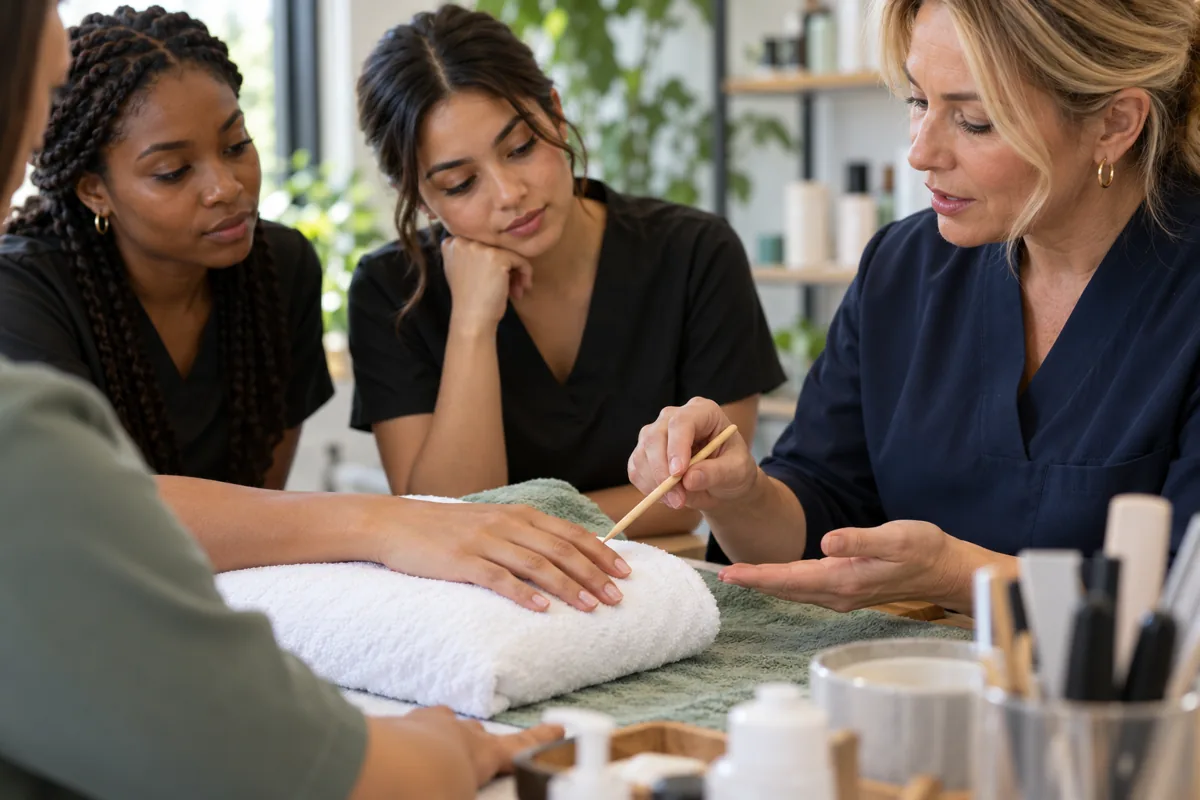
Learning goals
- Recognize structures and avoid treating disease.
- Explain the decision using the lesson principles.
- Apply the concept to a fictional case before supervised practice.
Name the structures
The nail plate is the visible hardened structure. The nail bed supports it; the matrix is the growth-producing area. The free edge extends beyond the fingertip. Knowing these terms helps you understand demonstrations and records.
Surrounding skin protects sensitive tissue. Do not treat all visible tissue as disposable. Cutting living skin or aggressive filing can injure the client; learn permitted techniques under supervision.
Observe before serving
Ask about pain and inspect for concerns before a nail service. Unexplained discoloration, swelling, open skin, separation, or drainage may require postponement and referral. A student should not label a condition from appearance alone.
Never hide a suspected problem under an enhancement simply to complete a booking. Explain what you observed and obtain instructor review while protecting the client’s dignity.
Protect the natural nail
A cosmetic product cannot replace missing medical assessment. Service suitability depends on the nail, skin, history, and approved method. Do not prescribe antifungal treatments or promise that covering a nail will cure it.
Use fictional cases here. Learn actual assessment, filing, and tool handling in school, where the instructor can see pressure, position, and client response.
Try the task
Draw and label the nail plate, free edge, and matrix.
Incomplete
1818. Manicure and pedicure planning
Organize a safe service and understand equipment responsibilities.Locked — complete previous lessons
18. Manicure and pedicure planning
Organize a safe service and understand equipment responsibilities.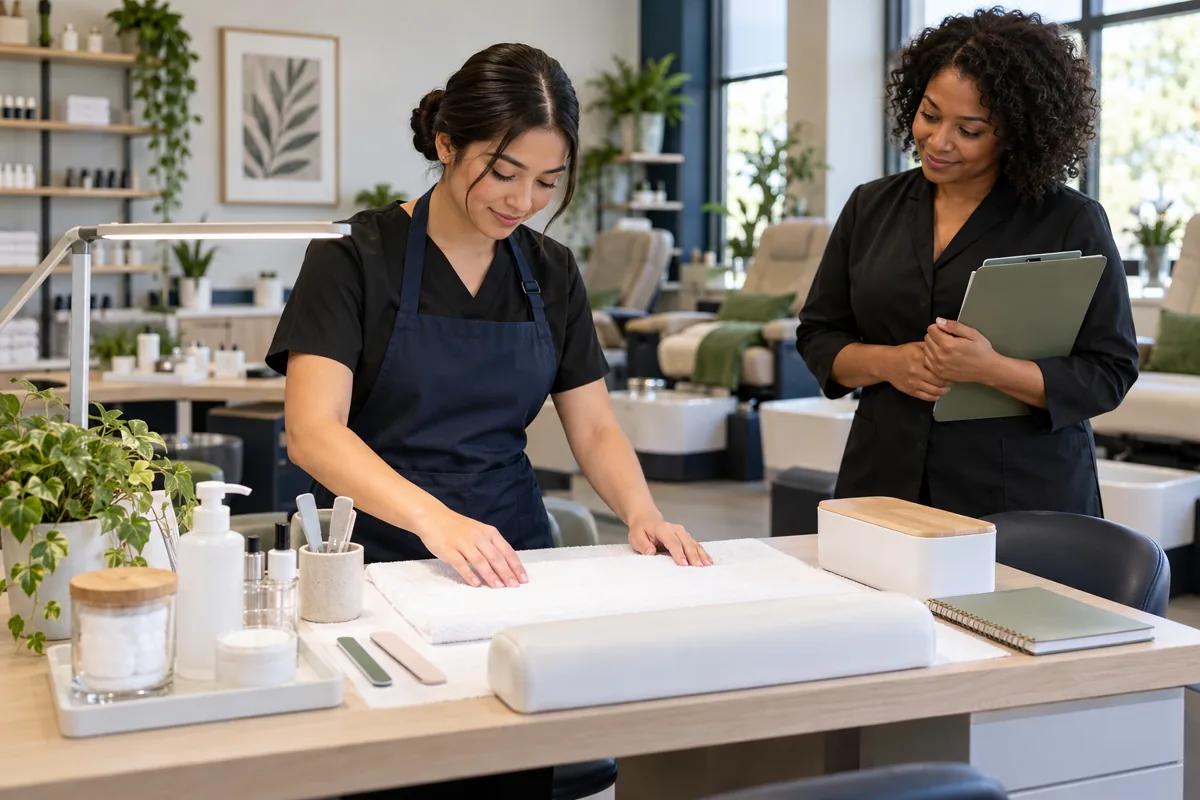
Learning goals
- Organize a safe service and understand equipment responsibilities.
- Explain the decision using the lesson principles.
- Apply the concept to a fictional case before supervised practice.
Prepare and assess
Begin with consultation, appropriate hand hygiene, and a clean station. Confirm service suitability before opening supplies. Use fresh single-use materials and correctly processed reusable tools.
Describe the sequence and invite the client to report discomfort. Shape and finish choices should reflect their preferences and permitted technique, not pressure to choose a more expensive service.
Pedicure equipment matters
Footspas and basins have equipment-specific cleaning and disinfection duties, including applicable records. A liner does not mean the underlying basin can be ignored. Confirm which procedure applies to the exact equipment in your school.
Logs should document completed work, not anticipated work. If processing cannot be verified, take the equipment out of service until it is appropriately prepared. Do not falsify a record to keep appointments moving.
Protect skin and comfort
Avoid service on unsuitable broken or irritated skin. Do not use a razor-edged callus-removal tool in a California establishment or school. Learn the allowed methods and limits rather than treating pain as proof of effectiveness.
Clients with additional health concerns may need qualified advice about service suitability. Do not promise that a pedicure treats a medical condition or perform a procedure beyond your role.
Try the task
Draft a fictional equipment-log entry without pretending the work occurred.
Incomplete
1919. Enhancements, polish systems, and safe removal
Learn product-system thinking rather than improvised combinations.Locked — complete previous lessons
19. Enhancements, polish systems, and safe removal
Learn product-system thinking rather than improvised combinations.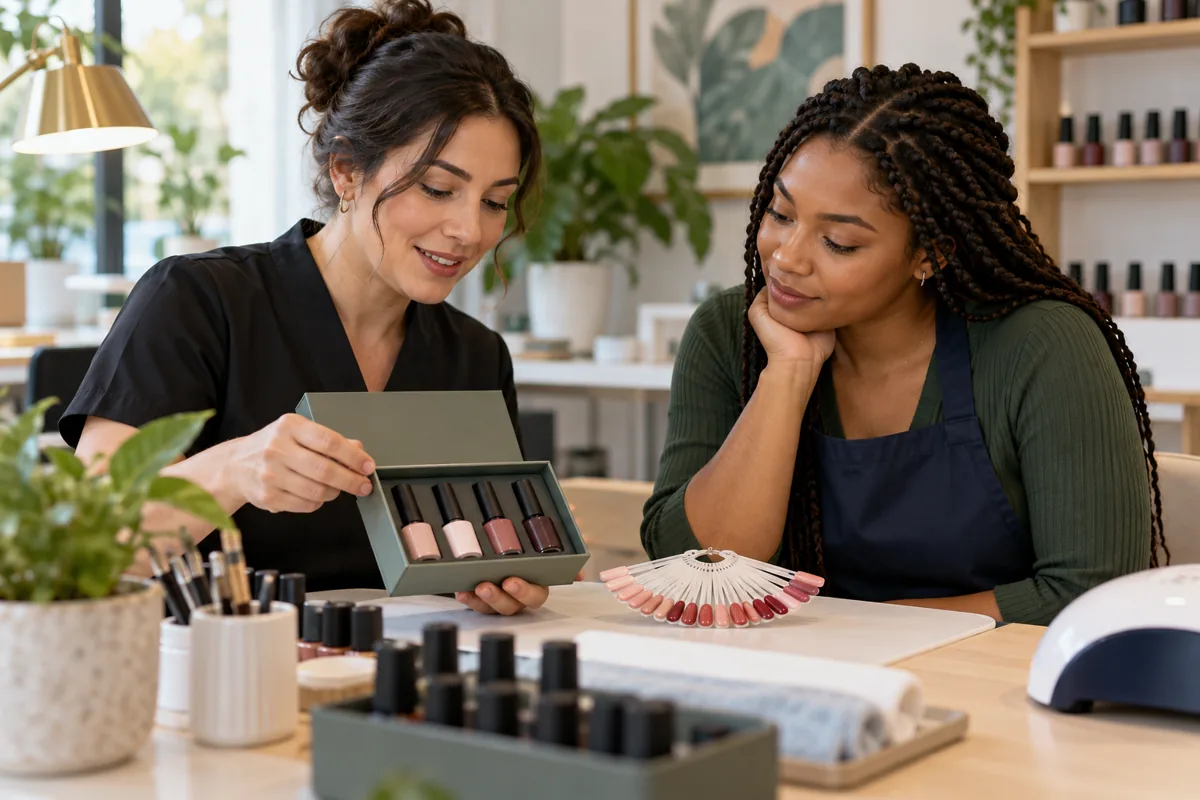
Learning goals
- Learn product-system thinking rather than improvised combinations.
- Explain the decision using the lesson principles.
- Apply the concept to a fictional case before supervised practice.
Different systems
Traditional polish, light-cured systems, and liquid/powder enhancements have different application and removal requirements. Matching products and equipment to manufacturer instructions is part of safe practice. One lamp is not automatically suitable for every system.
Do not combine unfamiliar products because their names sound similar. Proper curing and avoiding skin contact matter. Learn the full manufacturer system under supervision, not only the visible final coat.
Control product and dust
Use suitable ventilation and task-specific protection. Keep product off skin, close containers, and follow the SDS. Strong odor is not the only hazard indicator; odorless or free-from marketing does not establish zero risk.
Repeated skin exposure can lead to sensitization. Stop and report reactions instead of continuing to add product. Do not use this course to experiment with real enhancement chemicals.
Removal protects tissue
Removal method depends on the system. Pulling or prying an enhancement off can damage the natural nail. Excessive filing can also injure it. Follow a supervised removal procedure and respect client discomfort.
Discoloration, separation, or pain beneath a product requires assessment rather than concealment. A professional should be able to explain maintenance and removal limits before applying a service.
Try the task
Write three questions to ask before learning a new enhancement system.
Incomplete
2020. Inclusive service and difficult conversations
Use respectful language, boundaries, and practical accommodations.Locked — complete previous lessons
20. Inclusive service and difficult conversations
Use respectful language, boundaries, and practical accommodations.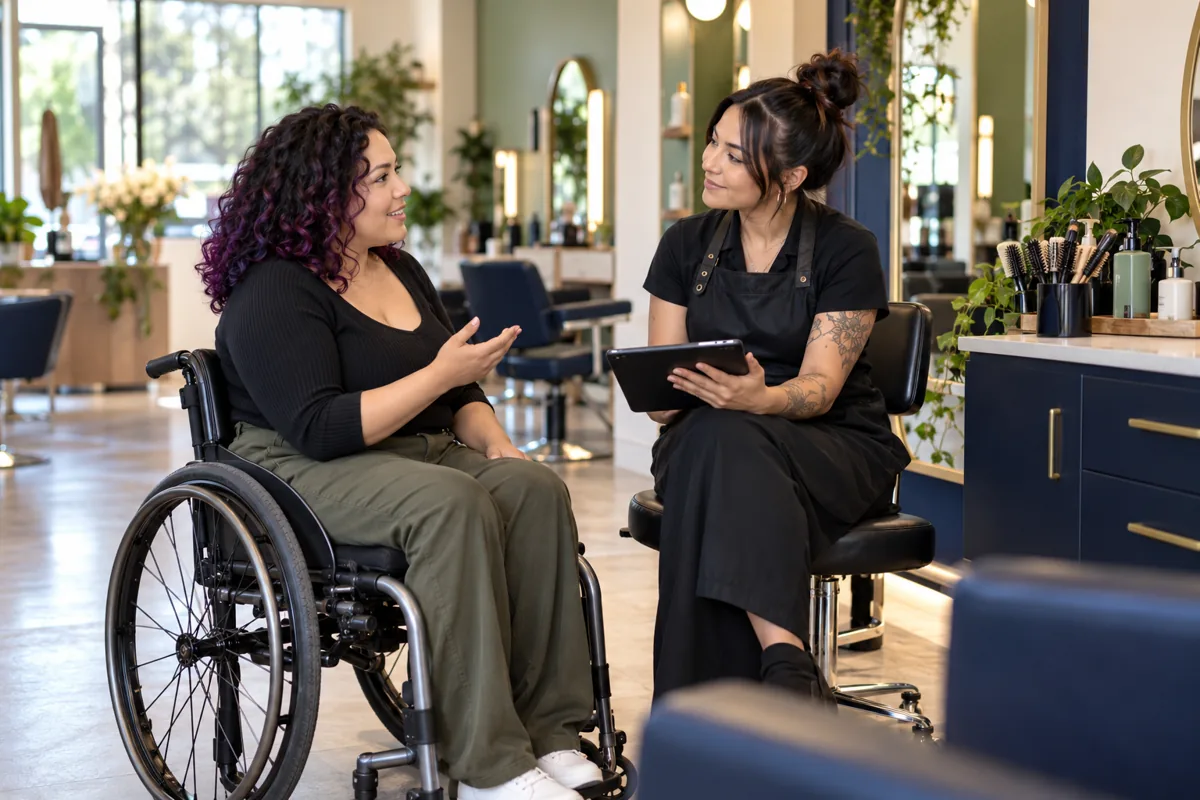
Learning goals
- Use respectful language, boundaries, and practical accommodations.
- Explain the decision using the lesson principles.
- Apply the concept to a fictional case before supervised practice.
Individual preferences
Ask how the client wants to be addressed and what result feels right to them. Do not assume hairstyle, gender expression, budget, or service preferences from appearance. Offer choices without implying one texture or feature needs fixing.
Accommodation can include explaining each step, checking sensory comfort, or adjusting positioning within safe limits. Ask what would help rather than making assumptions about disability.
Handle disagreement calmly
Listen to the concern and summarize it before responding. Clarify what was agreed and involve the instructor when the requested correction exceeds your skill or the safe plan. Do not argue publicly or promise a service you cannot provide.
A useful response separates empathy from guarantees: I understand the result feels different from what you expected. Let’s review the plan with my instructor. Follow the school policy for complaints and refunds.
Maintain boundaries
Decline unsafe or out-of-scope requests respectfully and explain the next option. You do not have to accept harassment or discriminatory demands. Ask for supervisor support rather than managing an escalating situation alone.
Privacy applies to stories as well as records. Do not post a complaint or client detail online to defend yourself. Use professional channels and objective notes.
Try the task
Write a response to an unhappy fictional client.
Incomplete
2121. Salon math, time, and ethical retail
Practice arithmetic without inventing chemical formulas.Locked — complete previous lessons
21. Salon math, time, and ethical retail
Practice arithmetic without inventing chemical formulas.
Learning goals
- Practice arithmetic without inventing chemical formulas.
- Explain the decision using the lesson principles.
- Apply the concept to a fictional case before supervised practice.
Service arithmetic
Separate service price, discounts, tax when applicable, and optional gratuity. Verify the jurisdiction’s tax treatment rather than assuming every service and product is taxed alike. Tell the client the price before adding a service.
For a paper exercise, a $40 service plus a $12 product totals $52 before any applicable tax or tip. A 10% discount on the $40 service is $4, not $5.20 if the product is excluded.
Plan realistic time
Allow time for consultation, preparation, service, instructor checks, and cleanup. A 45-minute service plus 15-minute preparation and 10-minute cleanup needs 70 minutes, not 45. Do not shorten a safety process to recover a late schedule.
Communicate delays and ask for help if the schedule is unrealistic. Track the cause of overruns as a learning issue, not as permission to skip consultation or processing instructions.
Recommend honestly
Recommend products for a stated need and explain cost, directions, and alternatives. Do not promise medical benefits or invent urgency. A client may decline a product without receiving worse service.
Commission or sales goals do not override suitability. Separate an educational recommendation from a guarantee. Keep financial records accurate and use the school’s approved payment process.
Try the task
Calculate a 15% discount on an $80 eligible service.
Incomplete
2222. Learning practical skills at school
Turn demonstrations into deliberate and supervised practice.Locked — complete previous lessons
22. Learning practical skills at school
Turn demonstrations into deliberate and supervised practice.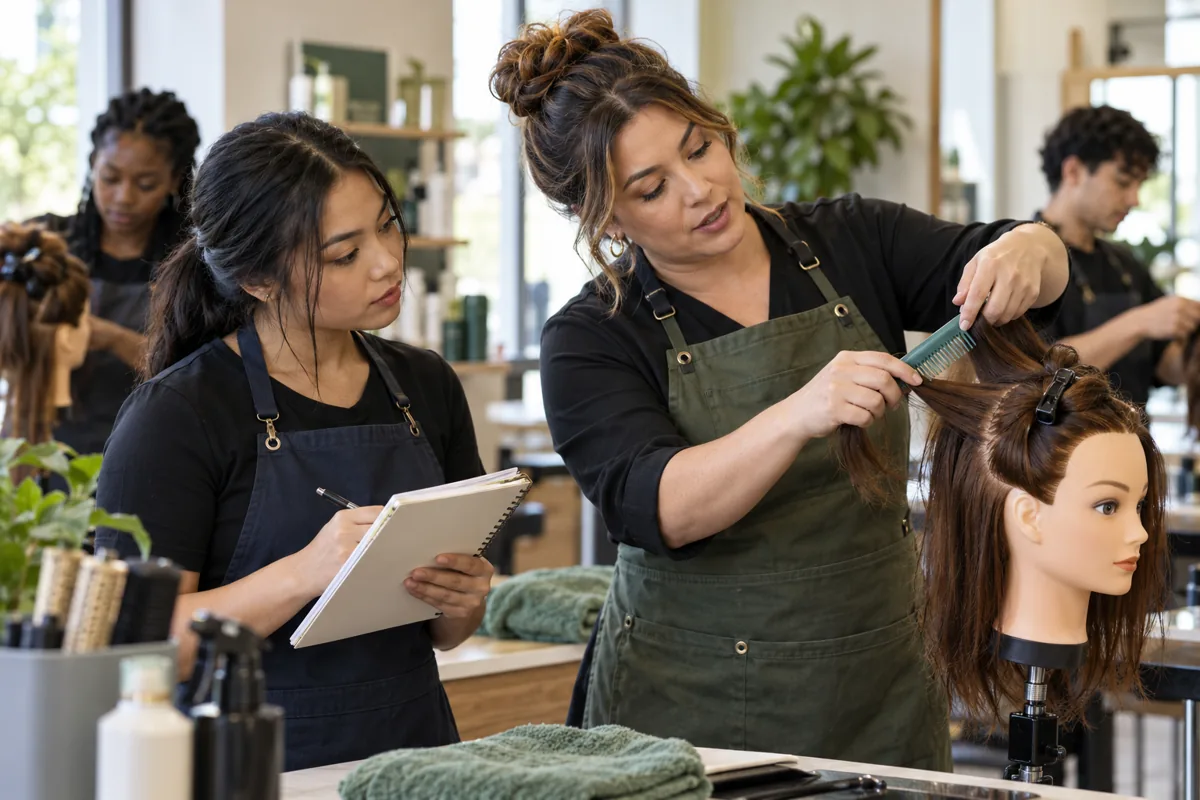
Learning goals
- Turn demonstrations into deliberate and supervised practice.
- Explain the decision using the lesson principles.
- Apply the concept to a fictional case before supervised practice.
Watch with a purpose
Before a demonstration, read the objective and identify the steps you do not understand. Observe setup, body position, tool handling, safety checks, and cleanup, not just the finished look. Ask why a step matters.
Write the sequence in your own words and compare it with the approved procedure. Do not assume watching once means you can safely perform it independently.
Practice and get feedback
Use the school’s permitted mannequin or supervised practice setting. Choose one focused improvement, such as section organization, and ask the instructor for observable feedback. Practice slowly enough to maintain safe technique.
A useful feedback note names the action and next attempt: my sections were too large; next time I will use the demonstrated smaller sections. Do not practice chemical or sharp-tool procedures on friends to bypass supervision.
Build a study routine
Review terms through retrieval: close the notes and explain the concept, then check accuracy. Space practice over multiple days. Keep an error log connecting the missed concept to a corrected explanation.
Alternate theory study with approved practical work. Exams measure knowledge; a written score cannot verify hand pressure, client protection, or tool competence. Be honest about both strengths and remaining needs.
Try the task
Create a two-day study plan for one skill.
Incomplete
2323. Licensing pathway and honest credentials
Understand the California example and verify your own jurisdiction.Locked — complete previous lessons
23. Licensing pathway and honest credentials
Understand the California example and verify your own jurisdiction.
Learning goals
- Understand the California example and verify your own jurisdiction.
- Explain the decision using the lesson principles.
- Apply the concept to a fictional case before supervised practice.
California school route
As reviewed in October 2026, California requires at least 1,000 hours of practical and technical instruction for a qualifying cosmetology school course. Examination eligibility also includes age, education, application, and other legal requirements; the school route is not the only recognized route.
The Board lists minimum curricular areas including health and safety, disinfection, hair services, skin care, and nails. Confirm current rules and your program’s approval directly with the Board before enrollment.
Training, exam, license
Completing approved education, meeting exam eligibility, passing the required examination, and receiving a license are separate steps. Do not advertise a license before it is issued. Fees and application procedures may change.
Use the official applicant resources for the current process. If you plan to move, ask the destination regulator about transfer or reciprocity; do not assume a license automatically covers every state.
Describe independent learning
You can say you studied LifeHelper cosmetology foundations and completed fictional decision exercises. You cannot claim approved school hours, clinical qualification, or Board endorsement from this course.
Prepare questions for an admissions adviser and keep your enrollment and official training records. A prep course is most valuable when it makes formal instruction easier to understand, not when it makes promises about passing.
Try the task
Write honest résumé wording for this course.
Incomplete
2424. Integrated salon readiness
Combine assessment, safety, communication, and escalation.Locked — complete previous lessons
24. Integrated salon readiness
Combine assessment, safety, communication, and escalation.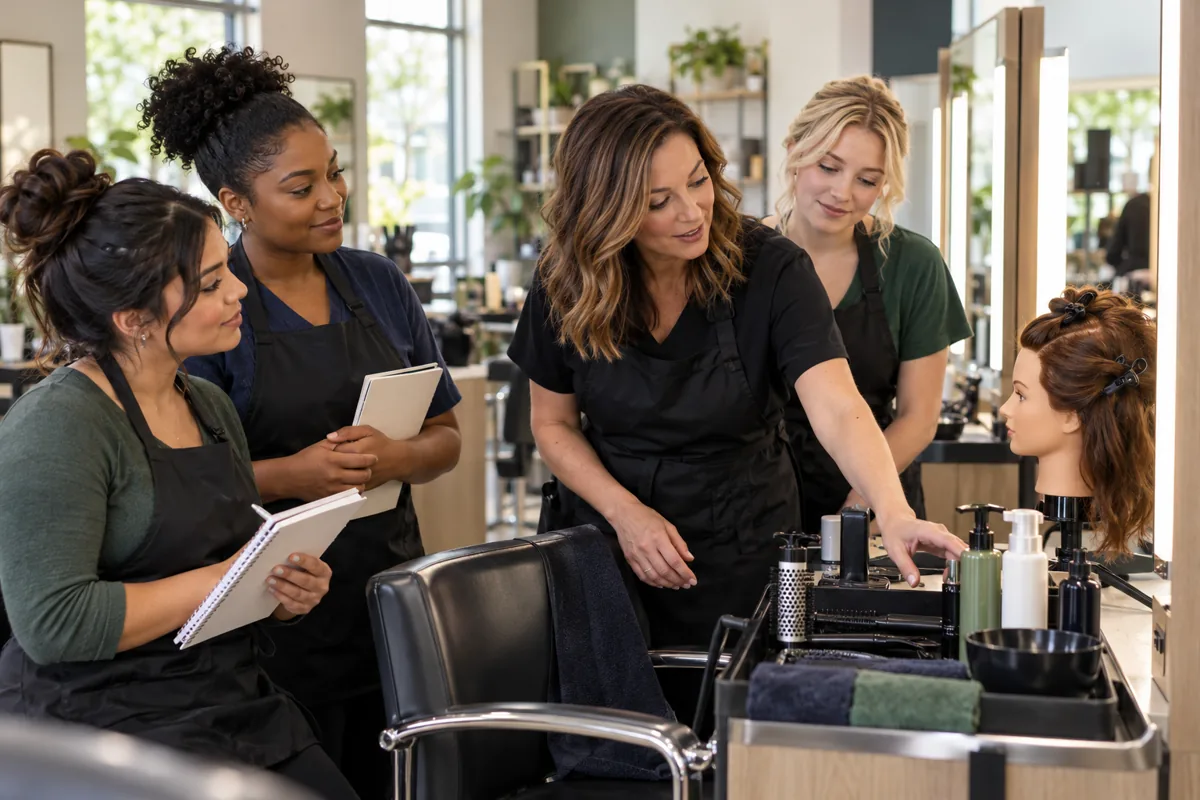
Learning goals
- Combine assessment, safety, communication, and escalation.
- Explain the decision using the lesson principles.
- Apply the concept to a fictional case before supervised practice.
A repeatable decision framework
Before any service, ask: Am I permitted and trained to do this? Is the client suitable today? Are the tools and products ready? Has the client agreed to a realistic plan? Is the instructor available where required?
A no or unknown answer is a reason to clarify, not a reason to rush. The framework helps you recognize missing information before an irreversible action.
Use a safe handoff
When escalating, state the goal, relevant history, observation, and the specific question. For example: the client wants color today, reports unknown prior straightening, and has fragile ends; please assess suitability. Avoid vague statements such as everything is fine.
Explain to the client what is happening and protect their privacy. Record the agreed change or deferral. Good judgment may mean no service today, even if the original request was popular or profitable.
Prepare for the first week
Bring the required supplies, review attendance and dress rules, locate the safety resources, and ask how assessments work. Make a realistic study schedule with recovery time. Use the exams here to identify concepts needing review.
Choose a formal course based on verified approval, instruction, supervision, cost, and fit. Continue practicing foundational knowledge, but let your qualified teachers teach and assess the actual procedures.
Try the task
Create a four-part handoff for an uncertain chemical request.
Incomplete
Reference resources and next steps
Course content reviewed October 2026. Training requirements, products, and procedures vary; check the current official instructions.
Milady Standard Cosmetology, 14th edition — curriculum referencePivot Point Fundamentals: Cosmetology — curriculum referenceCalifornia Board — licensing requirementsCalifornia Board — school resources and approved-school informationCalifornia Board — health and safety regulationsFDA — hair-dye safetyOSHA — nail-salon chemical hazardsOSHA — hair-product exposure controlsIndependent educational preparation only. This course is not a Board-approved school, does not supply licensing hours, and does not qualify you to perform services. Actual cutting, chemicals, skin and nail procedures require appropriate supervised instruction. No affiliation with Milady, Pivot Point, or a licensing board; all practice questions and cases are original. Requirements vary by location and can change.