Access Control
Check practice IDs, confirm permission, and complete the visitor log across five scenarios.
Start Access ControlApply your learning to fictional visitors and conversations. Review evidence, make decisions, and get feedback.
Check practice IDs, confirm permission, and complete the visitor log across five scenarios.
Start Access ControlHandle four situations using calm communication, clear boundaries, and safe judgment.
Start De-escalationLearn legal limits, de-escalation, observation, emergency response, and professional judgment through complete lessons and original practice exams.
Begin the lessonsLifeHelper is not a BSIS-approved training provider. This course supplies no required training hours or official certificate and does not replace authorized training, required in-person instruction, Live Scan, the official examination, or BSIS approval.
Confirm your provider, deadlines, permits, and current rules with BSIS. Reading these lessons does not count toward those hours.
Study each lesson, answer its knowledge check, and it completes automatically.

A California Guard Card is a security guard registration issued by the Bureau of Security and Investigative Services (BSIS). Applicants must be at least 18 and undergo DOJ and FBI criminal-history checks. A registration is not a police commission. An application receipt or a practice-course score is not approval to work.
The initial curriculum includes three hours of Power to Arrest and five hours of Appropriate Use of Force. Several force-related topics require in-person instruction. Required security-officer skills training adds 32 hours under the applicable deadlines, and annual continuing training is eight hours. Check the current BSIS syllabus and your authorized provider for how deadlines apply to registration and employment.
Complete authorized training, use the correct BSIS Security Guard Live Scan form, and submit the application and fees through BreEZe or the official paper process. Verify that BSIS has issued your registration. Pending receipt of the card, BSIS permits an approved registrant to work with a hard-copy approval printout and valid photo identification. Keep required training records and monitor renewal deadlines. This LifeHelper prep course provides no approved hours or training certificate.
Incomplete

A guard helps protect people and property, detects hazards, controls authorized access, and communicates concerns. Prevention and early reporting usually accomplish more than confrontation. Learn the site, emergency contacts, and boundaries of your assignment before working alone.
Post orders explain duties for a specific site: patrol areas, access rules, alarm responses, reporting contacts, and emergency procedures. Read them at the start of an assignment and ask for clarification. An employer instruction cannot authorize unlawful conduct. Report conflicting or unsafe orders through the proper channels.
Be honest, punctual, and respectful. Do not accept favors to overlook violations or falsely claim police authority. Protect confidential information, avoid conflicts of interest, and apply site rules consistently. Treat a visitor’s behavior and access status as relevant facts; appearance, race, religion, or disability alone do not establish suspicious conduct.
Incomplete

A security guard is generally a private person, not a peace officer. California Penal Code section 837 describes limited private-person arrest authority: a public offense committed or attempted in the person’s presence; an arrest when the person arrested has committed a felony; or when a felony has in fact occurred and there is reasonable cause to believe the person arrested committed it. These are distinct conditions, not permission to arrest anyone who seems suspicious.
An arrest can expose the guard and employer to serious civil and criminal liability. A uniform, radio, or employer request does not create police authority. Use observation, reporting, safe distance, and law-enforcement assistance when appropriate. Follow authorized training and employer policy; this lesson is not a practical arrest-technique course.
Do not assume you may search a person or seize belongings because you work security. Access-screening policies, consent, and lawful arrest issues require distinct legal analysis. A refusal to consent does not by itself establish a crime. Follow lawful site procedures and seek supervisory or law-enforcement assistance rather than using threats to obtain consent.
Incomplete

Stay calm and avoid insults, sarcasm, or threats. Before approaching, consider whether contact is necessary, whether you have an exit, and whether assistance is needed. Time, safe distance, and a less crowded environment can help reduce pressure. Do not corner someone simply to win an argument.
Introduce your role, speak clearly, and explain the rule or concern in plain language. Listen without interrupting, acknowledge the person’s concern, and offer lawful choices when possible. Give people time to process instructions. A calm tone does not require agreeing to unsafe or unauthorized conduct.
Hearing, language, disability, distress, or confusion can affect communication. Do not equate a delayed response with defiance. Ask what communication support would help, use authorized interpreter resources, and involve appropriate assistance. If there is immediate danger, prioritize safety and emergency response rather than continuing a conversation at close range.
Incomplete

Force is not a punishment or a tool for settling disrespect. Legal authority, necessity, proportionality, the actual circumstances, and less intrusive alternatives all matter. The BSIS curriculum addresses objectively reasonable force and its consequences. Complete required in-person instruction; online reading does not teach or authorize physical tactics.
A situation can change quickly. A response that might have been justified at one moment may no longer be justified after the threat ends. Do not continue force to teach a lesson. Follow lawful training and policy, seek assistance, and avoid escalating a property dispute into unnecessary physical confrontation.
The BSIS curriculum includes the duty to intercede and supervisory incident-reporting responsibilities. If you witness improper conduct, take appropriate action within your lawful role and safety constraints and promptly notify the proper authorities. After an incident, summon medical help when needed, preserve evidence, and accurately report what happened, including your own actions. Do not conceal misconduct or coordinate a false account.
Incomplete

Learn normal conditions at your site: locked doors, lighting, evacuation routes, occupied areas, and equipment status. Patrol according to post orders while remaining alert to changes. Do not enter an unsafe area or chase someone away from your assigned post merely to finish a patrol.
Write what you saw, heard, and did. Record the date, time, location, descriptions, sequence, witnesses, and notifications. Identify information received from others as such. Instead of writing that someone was a thief, describe the observed action and distinguish your suspicion from a proven fact.
Use clear, chronological language and relevant exact statements when you can accurately recall them. Correct errors through the approved process without hiding the original record. Preserve required records securely. Avoid sharing names, video, or private incident information on personal devices or social media without authorization.
Incomplete

Use the site’s approved identification and visitor process. Confirm appointments or credentials through authorized contacts, not an unfamiliar phone number supplied as the only proof. Apply rules consistently and politely. Keep sensitive visitor information secure and avoid announcing private details where bystanders can hear.
Tailgating occurs when someone follows an authorized person through a controlled entrance without completing the access process. Address it using lawful site procedures and safe communication. Do not lend keys, share access codes, or leave a controlled door open for convenience. Report lost keys or credentials immediately.
Know the radio channel, call signs, emergency terms, and reporting contacts. Give your identity, exact location, concise facts, and the assistance requested. Confirm important instructions when needed. Do not use jargon you have not been trained to use or broadcast unnecessary personal information.
Incomplete
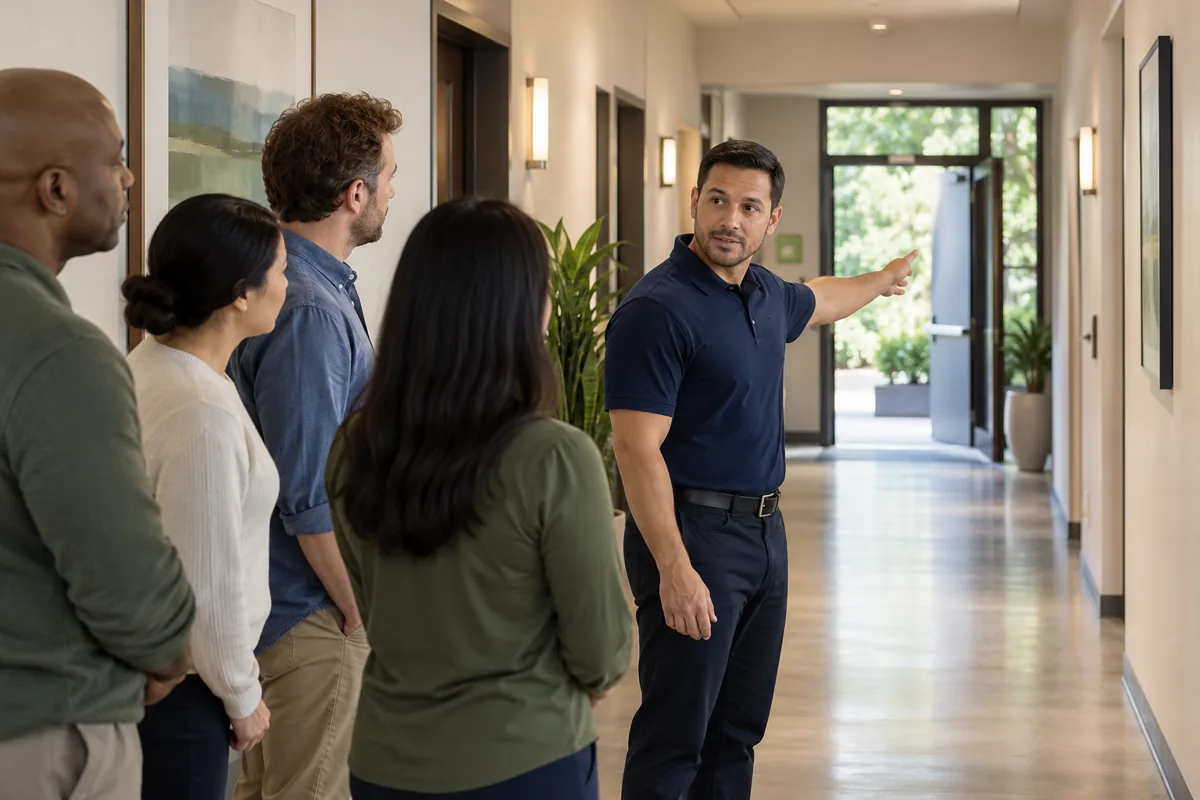
Before an emergency, learn exits, assembly points, emergency numbers, alarm procedures, and who coordinates response. Keep routes unobstructed and report hazards. During an evacuation, follow the site plan and instructions from emergency responders. Do not re-enter simply because an alarm becomes quiet.
Call emergency services promptly for serious injury, illness, smoke, or fire as appropriate. Give the exact location and hazards, keep yourself safe, and follow dispatcher instructions. Provide aid only within your training and circumstances. This prep does not certify CPR, first aid, or extinguisher use. Do not move an injured person unless immediate danger requires it.
If there is immediate violence, prioritize escape or shelter according to the situation and site plan, warn others when safe, and contact law enforcement. Do not approach to investigate a weapon or attempt an untrained intervention. With a suspicious item, avoid touching or moving it, isolate the area from a safe position, and use site procedures to notify authorities.
Incomplete

After an incident, protect the immediate area without exposing yourself or others to danger. Avoid unnecessarily moving objects, cleaning the scene, or letting bystanders disturb possible evidence. Lifesaving care takes priority. Tell responders about any changes made for safety or medical reasons.
Record witness contact details according to policy and respect consent and privacy. Ask neutral questions within your assignment. Do not coach witnesses, threaten them, promise outcomes, or combine everyone’s account into a story that hides differences. Record what each person reports separately.
When responders arrive, identify yourself, explain the immediate hazards, describe your observations and actions, and provide available records through authorized channels. Preserve relevant CCTV using the employer’s process. Follow evidence-handling and chain-of-custody procedures if authorized to handle evidence; do not take it home or copy it casually.
Incomplete

Keep your registration current, follow BSIS on-duty documentation rules, and maintain your required training records. Track renewal and continuing-training requirements rather than waiting for a reminder. Check the official rules for your assignment; specialized settings may require additional training.
A Guard Card alone does not authorize every weapon or piece of equipment. Firearms, batons, and tear gas have separate legal requirements, permits, or training obligations. Employer policy may be more restrictive. Do not carry equipment because a coworker says it is normal; verify the current BSIS requirements and your employer’s authorization.
Review post orders, emergency contacts, radio operation, documentation procedures, and reporting chains. Confirm that equipment works and that you know how to request backup. Ask about anything outside your training. Professional readiness means recognizing limits, preventing avoidable harm, and making honest reports—not pretending to know everything.
Incomplete
Each exam contains 20 questions covering all 10 lessons. Answer every question before submitting. Review every explanation and aim for 100%.
20 questions · complete answer review · unlimited retries
20 questions · complete answer review · unlimited retries
20 questions · complete answer review · unlimited retries
Requirements checked against BSIS resources on October 2, 2026. Always verify current requirements before enrolling or applying.
All 10 lessons; all three practice exams at 80% or higher; practice activities self-reviewed. Independent completion only, not official licensing.
Estimated study time: 7 hours. Includes reading, practice, projects and assessment; individual time varies.
Certificate locked — complete all requirements listed above. Existing progress is preserved.
Lifehelper estimates time from lesson length, worked exercises, practice sessions, project work and assessments. Short foundation courses use approximately two hours; larger courses and multi-level programs use higher estimates. This is not a timer, accredited credit or verified attendance.
Documents completion of an independent Lifehelper course. Not a license, accredited qualification, or official professional certification. Estimated study time is a course estimate, not verified activity hours.